
| |
|
|
 Odd Einar Olsen, Kirsten Voigt Juhl, Preben H. Lindøe, "Standardization and Risk Governance: A Multi-Disciplinary Approach" English | 2019 | ISBN: 0367259737 | PDF | pages: 307 | 4.1 mb This multi-disciplinary book conceptualizes, maps, and analyses ongoing standardization processes of risk issues across various sectors, processes, and practices.  Stalinism: New Directions (Rewriting Histories) By Sheila Fitzpatrick 1999 | 396 Pages | ISBN: 041515233X | PDF | 2 MB Sheila Fitzpatrick has put together an anthology of essays from the "new generation" of Russian/Soviet scholars to emerge within the last decade. The thread of methodology incorporated here harbors on the social/cultural with a sprinkling of post-modernism with its emphasis on rhetoric and language. All of the essays rely heavily on the availability of new archival sources since the collapse of the former Soviet Union in 1991. Sarah Davies ("'Us Against Them': Social Identity in Soviet Russia, 1934-41") reveals the "popular mood" of Soviet society through her analysis of anonymous hate mail sent to various ruling boroughs from the "little people" (pp. 47, 55). One is amazed at the oftentimes-brazen attacks coming from a population living within a "totalitarian" state that promotes terror to achieve its political ends. This article is one of the highlights of the book. The Soviet individual is the topic of three of the book's essays. Jochen Hellbeck's ("Fashioning the Stalinist Soul: The Diary of Stepan Podlubnyi, 1931-39) psychoanalysis of the diary of a Kulak's son to reveal one's inner turmoil of conforming to the new Soviet society raises some interesting questions about historical methodology. Vladimir A. Kozlov ("Denunciation and its Functions in Soviet Governance: From the Archive of the Soviet Ministry of Internal Affairs, 1944-53") employs a similar approach to explore motivations of written denunciations in the post World War II period. In a slightly different vain, Alexei Kojevnikov ("Games of Stalinist Democracy: Ideological Discussions in Soviet Sciences 1947-52") argues against the Lysenko model claiming not all Soviet scholars and scientist paid lip service to the ruling body. Other pieces take a look at the needs of Soviet society. Julie Hessler ("Cultured Trade: The Stalinist Turn Towards Consumerism") believes the mindset of Soviet citizens remained fixed on a "culture of shortages" in spite of official policies to promote a culture of consumerism (p. 194). Vadim Volkov (The Concept of Kul'turnost': Notes on the Stalinist Civilizing Process") explores the concept of Kul'turnost' (culturedness) before communism and how the Bolsheviks attempted to modify this intangible notion. As with many recent historians, Lewis H. Siegelbaum ("'Dear Conrade, You Ask What We Need': Socialist Paternalism and Soviet Rural 'notables' in the mid-1930's) also gleans from written letters to question the effectiveness of the Soviet reward and punishment system (paternalism) in the 1930's. Perhaps Volkov's article, though noteworthy, seems a bit out of place sandwiched between the other two contributions. Another section is devoted to the effects of terror on the lower rungs of Soviet society. James R. Harris ("The Purging of Local Cliques in the Urals Region, 1936-7") describes the "coping strategies" devised by the local regional (oblast) leadership to protect themselves from the state bureaucracies as well as, Stalin's reaction to them (p. 267). Paul M. Hagenloh ("'Socially Harmful Elements' and the Great Terror") shows the significance broad ranging crime (what he refers to as "marginal") and the police campaigns to combat it played in the overall picture of the Great Terror. Ethnicity and nationalism provide the themes of the final two essays. Yuri Slezkine ("The USSR as a Communal Apartment, or How a Socialist State Promoted Ethnic Particularism") shows that the Soviet regime exhibited a sympathetic attitude to nationalist/ethnic groups in spite of its proletarian ideology. In a jingoistic laced essay, Terry Martin ("Modernization or Neo-Traditionalism? Ascribed Nationality and Soviet Primordialism") utilizes the theory of nationalism (principally Earnest Gellner's interpretations) as "an excellent test case" (p. 350) to compare the modernization and neo-traditionalist paradigms invented by scholars as a means of studying Russia's diverse ethnic and national population. Complimenting Sheila Fitzpatrick's own contribution to this book ("Ascribing Class: The Construction of Social Identity in Soviet Russia"), Martin concludes it was the latter paradigm that reigns supreme in spite of the fact that Communism societies do not advocate a return to traditional modes of society. Undoubtedly recent archival material played heavily into the contributions of this book. Of course this is a positive step in the advancement of Russian historiography. An underlying idea throughout this collection of essays, however, prompts one to ask whether the plethora of newly available archival material is, in one respect, the tail wagging the dog. To clarify, we as historians are taught to begin by formulating an historical question, then consult primary and secondary evidence to conform or refute a thesis. Not that this methodology is carved in stone, still, by reading the contributions of the "new generation" of Russian scholars, this reviewer gets the impression that these researchers are working backwards. That is to say, they travel to the vast reservoirs of new material, collect whatever they can get their hands on and, only then, do they synthesize the material into a workable theory. The tail (new archival material) is wagging the dog (imaginative research). This point is well illustrated in Mark von Hagen's article ("The Archival Gold Rush and Historical Agendas in the Post-Soviet Era," Slavic Review, April, 1993) and magnified within this collection of essays.  Stagolee Shot Billy By Cecil Brown 2003 | 305 Pages | ISBN: 0674010566 | PDF | 2 MB As disappointed as I am by the other reviewers here, is how overjoyed I am, now that I have read this book. Upon coming across this book wandering in a book store (sorry, Amazon), I literally tossed aside the other books in my hands and proceeded to read most of the book in the store, before rushing up to the register and tossing over my hard-earned cash for this incredible story!I had heard the song - the Lloyd Price version - on oldies stations as a child; it had never occurred to me that it might actually be based upon a true story. And once that possibility came to light, I needed to know everything there was to know about Stagger Lee. But the more the is to learn about Stagger, the more there is to know, as myth and legend are wound together with what we believe we know to be true.The author tries to bring us along the path he took, the journey he made to uncover the real Stagger Lee; this leads to what the other reviewers decribe as "poor editing", when what we thought we learned as fact on one page turns into just another rumor. And when you have a story that grows as organically as this one has and a tale with this many authors who claim to be the original, then this is bound to happen.At the end, even being able to say, "we think this is how it went down", provides a fascinating case study of late 19th century Negro life, in that post-slavery, post-Reconstruction world in which being black meant anything you were able to claim as your own was tenuous, at best. And sometimes, getting into a fight over a hat was the best choice to be made.  Sports Management and Administration By David Watt 1998 | 268 Pages | ISBN: 0419196404 | PDF | 1 MB Sport is a rapidly expanding business and a key sector of the national economy. Better training for sports administrators and managers and improved standards of sports organisation are essential if this growth is to be sustained. This practical, ground-breaking handbook examines key issues previously unexplored in a sport context. By outlining management principles and procedures it aims to improve the knowledge of those studying or working in sport. Sports Management and Administration will be of benefit to those working in the voluntary or private sectors, in local or national agencies, as well as those employed by local authorities. It will be particularly useful for sport development officers, sports administrators and managers, and those working for governing bodies of sports and national or local sports councils.  Douglas S. Massey, Stefanie Brodmann, "Spheres of Influence: The Social Ecology of Racial and Class Inequality" English | 2014 | ISBN: 0871546434 | EPUB | pages: 451 | 6.8 mb The black-white divide has long haunted the United States as a driving force behind social inequality. Yet, the civil rights movement, the increase in immigration, and the restructuring of the economy in favor of the rich over the last several decades have begun to alter the contours of inequality. Spheres of Influence, co-authored by noted social scientists Douglas S. Massey and Stefanie Brodmann, presents a rigorous new study of the intersections of racial and class disparities today. Massey and Brodmann argue that despite the persistence of potent racial inequality, class effects are drastically transforming social stratification in America. This data-intensive volume examines the differences in access to material, symbolic, and emotional resources across major racial groups. The authors find that the effects of racial inequality are exacerbated by the class differences within racial groups. For example, when measuring family incomes solely according to race, Massey and Brodmann found that black families' average income measured $28,400, compared to Hispanic families' $35,200. But this gap was amplified significantly when class differences within each group were taken into account. With class factored in, inequality across blacks' and Hispanics' family incomes increased by a factor of almost four, with lower class black families earning an average income of only $9,300 compared to $97,000 for upper class Hispanics. Massey and Brodmann found similar interactions between class and racial effects on the distribution of symbolic resources, such as occupational status, and emotional resources, such as the presence of a biological father―across racial groups. Although there are racial differences in each group's access to these resources, like income, these disparities are even more pronounced once class is factored in. The complex interactions between race and class are apparent in other social spheres, such as health and education. In looking at health disparities across groups, Massey and Brodmann observed no single class effect on the propensity to smoke cigarettes. Among whites, cigarette smoking declined with rising class standing, whereas among Hispanics it increased as class rose. Among Asians and blacks, there was no class difference at all. Similarly, the authors found no single effect of race alone on health: Health differences between whites, Asians, Hispanics, and blacks were small and non-significant in the upper class, but among those in the lower class, intergroup differences were pronounced. As Massey and Brodmann show, in the United States, a growing kaleidoscope of race-class interactions has replaced pure racial and class disadvantages. By advancing an ecological model of human development that considers the dynamics of race and class across multiple social spheres, Spheres of Influence sheds important light on the factors that are currently driving inequality today.  Speed Reading: How to Read a Book a Day - Simple Tricks to Explode Your Reading Speed and Comprehension by Ryan James English | August 22, 2019 | ISBN: 1951030966 | 96 pages | EPUB | 0.21 Mb Accelerated Learning Series Book #2  Snake (Object Lessons) by Erica Wright English | 2020 | ISBN: 150134871X | 161 Pages | PDF | 3.66 MB 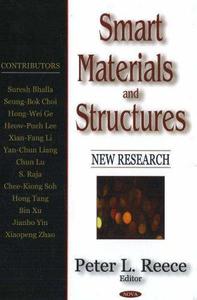 Smart Materials And Structures: New Research By Peter L. Reece 2007 | 304 Pages | ISBN: 1600211070 | PDF | 7 MB 'Smart' materials respond to environmental stimuli with particular changes in some variables. For that reason they are often also called responsive materials. Depending on changes in some external conditions, 'smart' materials change either their properties (mechanical, electrical, appearance), their structure or composition, or their functions. Mostly, 'smart' materials are embedded in systems whose inherent properties can be favourably changed to meet performance needs. Smart materials and structures have widespread applications in: Materials science - composites, ceramics, processing science, interface science, sensor/actuator materials, chiral materials, conducting and chiral polymers, electrochromic materials, liquid crystals, molecular-level smart materials, biomaterials; sensing and actuation - electromagnetic, acoustic, chemical and mechanical sensing and actuation, single-measurand sensors, multiplexed multimeasurand distributed sensors and actuators, sensor/actuator signal processing, compatibility of sensors and actuators with conventional and advanced materials, smart sensors for materials and composites processing; and, optics and electromagnetics - optical fibre technology, active and adaptive optical systems and components, tuneable high-dielectric phase shifters, tuneable surface control. It also have applications in: structures - smart skins for drag and turbulence control, other applications in aerospace/hydrospace structures, civil infrastructures, transportation vehicles, manufacturing equipment, repairability and maintainability; control - structural acoustic control, distributed control, analogue and digital feedback control, real-time implementation, adaptive structure stability, damage implications for structural control; and, information processing - neural networks, data processing, data visualisation and reliability. This book presents leading research from around the globe in this field. 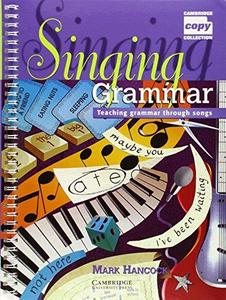 Singing Grammar: Teaching Grammar through Songs (Cambridge Copy Collection) By Mark Hancock 1999 | 98 Pages | ISBN: 0521625424 | PDF | 12 MB Singing Grammar is part of the Cambridge Copy Collection. It is a resource book of supplementary materials for the teaching of grammar through the medium of song. It contains eighteen songs, each with a specific grammar focus, and is suitable for students from elementary to intermediate level. For each of the songs there is a clear page of teachings notes followed by a motivating song worksheet, a grammar exercise page and a fun grammar game for classroom use. The material is especially suitable for younger learners but could also be used successfully with adults.* songs specifically written for different age groups and levels* variety of musical styles* step-by-step instructions and tips for teachers* range of exercise types* photocopiable worksheets and games* useful pop music glossary* alternative karaoke or slow version for each song* Songbook containing lyrics and chords  Simplified Sheet Metal Concepts & Design by Ashok Kumar English | 2020 | ASIN: B08LSHBQBP | 341 Pages | PDF | 46 MB |

 :
:
