
| |
|
|
 MP4 | Video: h264, 1920x1080 | Audio: AAC, 44.1 KHz, 2 Ch Difficulty: Beginner | Genre: eLearning | Language: English | Duration: 12 Lessons (3h 29m) | Size: 3 GB If you are looking to build a snowman this holiday season, you've come to the right place! The main focus of this course is to learn how to develop models and materials efficiently, procedurally and as flexibly as possible, all using built-in Blender functionality! 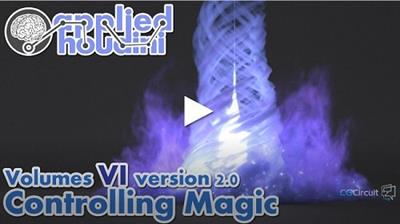 MP4 | ENG | Video: h264, yuv420p, 1280x720 | Audio: aac, 44100 Hz | Duration: 4h:23m:25s | Size File: 3.77 GB Genre: eLearning Applied Houdini is here with one of my most exciting lessons yet - Volumes VI, Controlling magic! In this lesson we're going create a multi-layered magical scene using all kinds of advanced volume manipulation techniques. Instead of always using Pyro, we'll begin by creating procedurally generated volumes that look great but are actually designed without simulation. Much of this will be accomplished via art directable volume deformations, with two different robust techniques implemented efficiently in VEX code. In addition to shading, lighting, rendering, and compositing topics, we'll also design a custom vortex velocity field in order to drive some final simulations. By the end of this lesson, you'll have the confidence to control any kind of volume effect, both magical or otherwise!  MP4 | ENG | Video: h264, yuv420p, 1920x1080 | Audio: aac, 44100 Hz | Duration: 1h:30m | Size File: 373 MB Genre: eLearning Polymer is Bitwig Studio's powerful new hybrid modular synth. Dive deep into its limitless synthesis possibilities in this fun and informative course by Bitwig Certified Trainer, Thavius Beck.  Artstation | by Jay Cummings Duration: 1h 10m | Video: 1920x1080, 44kHz | 898 MB Genre: eLearning | Language: English | Skill Level: Intermediate  Artstation | by Pablo Muñoz Gomez Duration: 2 hours | Video: 1920x1080, 48kHz | 645 MB Genre: eLearning | Language: English | Skill Level: Intermediate  MP4 | Video: h264, 1920x1080 | Audio: AAC, 48 KHz, 2 Ch Genre: eLearning | Language: English +.vtt +.srt | Duration: 1h41m | Size: 1.41 GB We are going to learn 6 Landscape paintings in 15 Minutes. It's going to be a quick and simple class where we start by learning about the materials required, Techniques of 8 types and finally 6 Landscapes across different times of the day. Morning, evening, Northern Lights, clouds & reflection is what we are going to cover.  Work and mental health by The Open University English | March 1, 2018 | ISBN: N/A | ASIN: B07H99FFJG | 51 pages | Rar (PDF, AZW3) | 0.68 Mb Although being at work during periods of mental illness can be difficult for those with mental health problems, most people with these difficulties could take paid employment if it were not for numerous barriers in the workplace and the wider community. In this course, Work and mental health, you will look at some of the ways in which employment affects mental health and what can be done to support people in finding and keeping work.  Virus vs. Bacteria : Knowing the Difference - Biology by Baby Professor English | September 15, 2017 | ISBN: 1541938917 | 64 pages | Rar (PDF, AZW3) | 5.43 Mb Did you know that how you got sick will determine what treatment methods will work for you? If you were infected by a virus, doctors normally would just allow your immune system to fight it. If you were infected by a bacteria, on the other hand, antibiotics would work. In this book, you're going to learn to spot the differences between the virus and the bacteria.  Understanding operations management by The Open University English | March 1, 2018 | ISBN: N/A | ASIN: B015RGRVIK | 51 pages | Rar (PDF, AZW3) | 0.56 Mb Operations management is one of the central functions of all organisations. This course, Understanding operations management, will provide you with a basic framework for understanding this function, whether producing goods or services or in the private, public or voluntary sectors. In addition, this OpenLearn course discusses the role of operations managers and the importance of focusing on suppliers and customers.  Understanding Consciousness By Max Velmans 2009 | 406 Pages | ISBN: 0415425158 | PDF | 3 MB (This differs somewhat from my review in the Journal of Consciousness Studies from 10 years ago.)This is a fine book. In what has become a crowded field, it stands out as direct, deep, and daring. It should place Max Velmans amongst the stars in the field like Chalmers, Dennett, Searle, and Churchland who are most commonly referenced in consciousness studies books and articles. It is direct in that the de rigueur history and review of the body-mind problem is illuminating and concise. It is deep in that Velmans deconstructs the usual idea of an objective world as distinct from our experienced world. It is daring in that in his last chapter he comes out on the side of consciousness co-evolving with the universe rather than arising at some point within it (though he insists that such speculation is beyond the more empirical intent of his earlier chapters). His views on a 'physicalism' with mental qualities predate the now popular views of Galen Strawson, who says much the same thing without giving Velmans credit.Anti-reductionism. Velmans, like others, insists that the phenomenology of consciousness is just as important as any theories about consciousness. First person experience is vital to any understanding of consciousness. After all, the phenomenal world cannot exist without an observer. The brain itself is part of the experienced world and this is one the reasons he makes it clear that any sort of reductionism, including functionalism, just won't do as a prospective account of consciousness. He calls for an ontological monism, the universe, with a dual epistemology, the first- and third-person perspectives within it. Several times he denies that neural processes can be identical to consciousness even if they cause or correlate with them. His mantra is "correlation and causation do not establish ontological identity." As perceived, the world cannot help but be subjective. Even the world as revealed through scientific instruments is interpreted and theorized over by conscious minds. In this way, separating subjective and objective realities creates a false dichotomy. The world as experienced is intersubjectively verified and it is this we accept as reality. This world is not the thing-in-itself, as Kant forever made clear. It is not knowable in itself. That world seems to consist of energy exchanges and every perceptive-cognitive system creates a unique reality from it.Reflexive monism. There simply is no reality to be experienced without an experiencing consciousness. At this point, it may seem he has idealized the mind and its place in existence, but those who hope for such a perspective may be slightly disappointed. Noting that most of the information processing of the mind is non-conscious or pre-conscious, he finds little for consciousness to actually do. Consciousness, he suggests, may be either the result of focal-attentive processing or, similarly, the result of inhibiting less important processing from achieving conscious attention. He notes the time-delay, made famous by Libet, in actual awareness of decisions already pre-consciously made. But, contra Libet, he also contends that even seemingly "spontaneous" conscious vetoes must have been preceded by some sort of pre-conscious processing. The universe is, as physics has taught us, a closed physical system so, on occasion, Velmans appears to come out on the side of determined causation in the free-will debate, yet other times he speaks for a larger freely-willing mind of which consciousness is but the tail end.This is strong medicine from one who so valorizes consciousness and the absolutely vital role it plays in giving us a reality. Without consciousness, there would be nothing, no existence for anything. Yet, according to Velmans, consciousness most often has no actual role to play in determining reality. A more interesting corollary of his reflexive monism is that consciousness itself did not appear as the result of evolutionary processes -- except in the sense that its form has changed along with that of the material entities which carry it -- but in some essential sense was always present. This appears to put Velmans in the panpsychist school of thought, but, if so, that school of thought is only strengthened by his clear, consistent, and insightful approach.Though Velmans attempts to excuse his last chapter as speculative, his notion of consciousness being coterminous (he calls it "continuous") with the physical universe is refreshing, but opens the usual conceptual quagmire of dualism that he is in danger of collapsing into. He spends a good deal of time attacking the formulation of David Chalmers, even though Chalmers has also suggested that experience may be a natural, universal property. He notes that Chalmers simultaneously claims consciousness as an emergent supervenience on the brain which Velmans sees as a contradiction to Chalmers's "panpsychofunctionalism" (Velmans' term). What Velmans does not deal with is how he can avoid the double-aspect nature of any physicalism that is also experiencing. Still, his support of panpsychism is bold and praiseworthy and should not be ignored -- and, again, its form is almost exactly copied in Galen Strawson's physicalist panpsychism.Conclusion. My quibbles are intellectual and minor and are overwhelmed by the strength of his major argument for an ontological, reflexive monism that includes awareness. His epistemological dualism remains a double-aspect dualism, but he makes a convincing argument for overcoming it by calling for asymmetrical but complementary perspectives of first- and third-person on conscious phenomena. He could have noted that both perspectives are subject to the consensus negotiations of the second-person. All in all, a stimulating read which emphasizes some fundamental truths which are too often overlooked in consciousness studies. It is also important in that it opens channels to discussion about matters which have been excluded by mainstream science on faith in objective materialism (mechanistic physicalism) alone. |

 :
:
