
| |
|
|
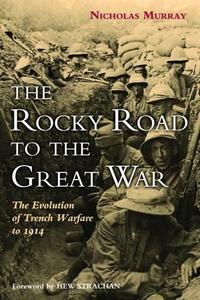 The Rocky Road to the Great War: The Evolution of Trench Warfare to 1914 By Nicholas Murray 2013 | 320 Pages | ISBN: 1597975532 | EPUB | 7 MB Nicholas Murray s "The Rocky Road to the Great War" examines the evolution of field fortification theory and practice between 1877 and 1914. During this period field fortifications became increasingly important, and their construction evolved from primarily above to below ground. The reasons for these changes are crucial to explaining the landscape of World War I, yet they have remained largely unstudied.The transformation in field fortifications reflected not only the ongoing technological advances but also the changing priorities in the reasons for constructing them, such as preventing desertion, protecting troops, multiplying forces, reinforcing tactical points, providing a secure base, and dominating an area. Field fortification theory, however, did not evolve solely in response to improving firepower or technology. Rather, a combination of those factors and societal ones for example, the rise of large conscript armies and the increasing participation of citizens rather than subjects led directly to technical alterations in the actual construction of the fieldworks. These technical developments arose from the second wave of the Industrial Revolution in the late nineteenth century that provided new technologies that increased the firepower of artillery, which in turn drove the transition from above- to belowground field fortification.Based largely on primary sources including French, British, Austrian, and American military attach reports Murray s enlightening study is unique in defining, fully examining, and contextualizing the theories and construction of field fortifications before World War I.  The Rise, Fall, and Rebirth of Chicago: The History and Legacy of America's Third Largest City by Charles River Editors English | December 30, 2018 | ISBN: N/A | ASIN: B07MP7WZ6Y | 280 pages | EPUB | 9.40 Mb *Includes pictures  Deborah Rudacille, "The Riddle of Gender: Science, Activism, and Transgender Rights" English | 2005 | ISBN: 0375421629, 0385721978 | 385 pages | EPUB | 2.5 MB When Deborah Rudacille learned that a close friend had decided to transition from female to male, she felt compelled to understand why.  Mary L. Trump, "The Reckoning: Our Nation's Trauma and Finding a Way to Heal" English | ISBN: 1250278457, 1838954422 | 208 pages | PDF | 2 MB From the #1 bestselling author of Too Much and Never Enough: A diagnosis of America's national trauma, and a way to heal.  The Raw Westside Bundle: Using The Conjugate Method for Raw Powerlifting by Jacob Rothenberg English | May 22, 2017 | ISBN: 1546824081 | 86 pages | EPUB | 0.42 Mb You get:  Steven Taylor, "The Psychology of Pandemics" English | ISBN: 1527549003 | 2020 | 178 pages | EPUB | 0,2 MB [center]  The Progressive in 19th-Century English: A Process of Integration By Erik Smitterberg 2005 | 284 Pages | ISBN: 904201735X | PDF | 4 MB The present volume is an empirical, corpus-based study of the progressive in 19th-century English. As the 1800s have been relatively neglected in previous research, and as the study is based on a new cross-genre corpus focusing on this period (CONCE = A Corpus of Nineteenth-Century English), the volume adds significantly to our knowledge of the historical development of the progressive. The use of two separate measures enables an accurate account of the frequency development of the progressive, which is also related to multi-feature/multi-dimensional analyses. Other topics covered include the complexity of progressive verb phrases and the distribution of the construction across linguistic parameters such as clause type. Special attention is paid to progressives that express something beyond purely aspectual meaning. The results show that the progressive became more fully integrated into English grammar over the 19th century, but also that linguistic and extralinguistic parameters affected this integration process; for instance, the construction was more common in women s than in men s private letters. Owing to the wide methodological scope of the study, it is of interest to linguists specializing in corpus linguistics, language variation and change, verbal syntax, the progressive, or the linguistic expression of aspect, either in synchrony or diachrony."  Elizabeth Siberry, "The New Crusaders: Images of the Crusades in the 19th and Early 20th Centuries " English | ISBN: 1859283330 | 2000 | 256 pages | PDF | 5 MB This is the first comprehensive study of the use, abuse and development of the crusade image in popular and high culture in the nineteenth and early twentieth centuries. Drawing upon a diverse range of sources, mainly from the British Isles, but with parallels from Western Europe and North America, the author shows the different approaches to the history of the crusading movement and crusade images taken by the historian, composer, artist and author.  The Most Dangerous Animal: Human Nature and the Origins of War By David Livingstone Smith 2007 | 288 Pages | ISBN: 031234189X | EPUB | 1 MB Almost 200 million human beings, mostly civilians, have died in wars over the last century, and there is no end of slaughter in sight.The Most Dangerous Animal asks what it is about human nature that makes it possible for human beings to regularly slaughter their own kind. It tells the story of why all human beings have the potential to be hideously cruel and destructive to one another. Why are we our own worst enemy? The book shows us that war has been with us---in one form or another---since prehistoric times, and looking at the behavior of our close relatives, the chimpanzees, it argues that a penchant for group violence has been bred into us over millions of years of biological evolution. The Most Dangerous Animal takes the reader on a journey through evolution, history, anthropology, and psychology, showing how and why the human mind has a dual nature: on the one hand, we are ferocious, dangerous animals who regularly commit terrible atrocities against our own kind, on the other, we have a deep aversion to killing, a horror of taking human life. Meticulously researched and far-reaching in scope and with examples taken from ancient and modern history, The Most Dangerous Animal delivers a sobering lesson for an increasingly dangerous world.  The Mighty Advisor: How thought disruptors galvanise leaders and reshape organisations by Tony Sedgwick English | August 2, 2021 | ISBN: 1781336059 | 170 pages | EPUB | 1.64 Mb Have you ever wanted to meet a real-life Merlin or Gandalf - someone with the power to transform the way you think and what you can achieve? |

 :
:
