The Last Gasp of Robert E. Lee's Army of Northern Virginia The Siege of Petersburg and the Appomattox Campaign
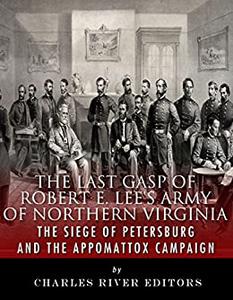
The Last Gasp of Robert E. Lee's Army of Northern Virginia: The Siege of Petersburg and the Appomattox Campaign by Charles River Editors
English | April 29, 2015 | ISBN: 1511945192 | 108 pages | EPUB | 2.73 Mb
*Includes pictures *Includes accounts of the fighting written by generals and soldiers on both sides *Includes online resources and a bibliography for further reading *Includes a table of contents "I have seen your despatch expressing your unwillingness to break your hold where you are. Neither am I willing. Hold on with a bulldog grip, and chew and choke as much as possible." - President Abraham Lincoln to Ulysses S. Grant, August 1864 After the last major pitched battle of the Overland Campaign was fought at Cold Harbor in early June, Ulysses S. Grant's Army of the Potomac had suffered more casualties during the campaign than Robert E. Lee had in his entire Army of Northern Virginia at the start of May. Understandably, the American public was shocked by the carnage, and to this day Grant has been accused of being a butcher, but attrition had become a vital war aim for the North, and Grant remained undeterred. Refusing to attack Lee in frontal assaults, and aware that Lee dared not venture out to counterattack, Grant nearly captured Richmond in mid-June by stealing a march on Lee's army and crossing the James River. The fog of war, poor luck, and a skillful impromptu defense by P.G.T. Beauregard stopped Grant from taking Petersburg, which was a critical railroad hub and supply line for Richmond, before Lee's army could confront, thereby saving the Confederacy for the time being. The two armies began to dig in around Petersburg, and unbeknownst to them they would be there for the next 9 months, constructing elaborate trenches and engaging in the kind of warfare that would be the forerunner of World War I. Both sides engaged in innovative and unique attempts at mining underneath the enemy's siege lines, as well as countermining, which led to the famous Battle of the Crater that turned an ingenious engineering feat into a Union debacle. Lee's attempts to break the siege by threatening Washington and trying to fight Grant's army proved just as futile. On April 2, the long siege of Petersburg by Ulysses S. Grant ended with Robert E. Lee's Army of Northern Virginia finally having its line broken, forcing Lee to retreat and give up Richmond in the process. Lee's battered army began stumbling toward a rail depot in the hopes of avoiding being surrounded by Union forces and picking up much needed food rations. While Grant's army continued to chase Lee's retreating army westward, the Confederate government sought to escape across the Deep South. On April 4, President Lincoln entered Richmond and toured the home of Confederate President Jefferson Davis. Fittingly, the food rations Lee moved toward did not arrive as anticipated, and on April 7, 1865, Grant sent Lee the first official letter demanding Lee's surrender. In it Grant wrote, "The results of the last week must convince you of the hopelessness of further resistance on the part of the Army of Northern Virginia in this struggle. I feel it is so, and regret it as my duty to shift myself from the responsibility of any further effusion of blood by asking of you the surrender of that portion of the Confederate States army known as the Army of Northern Virginia." Passing the note to General Longstreet, now his only advisor, Longstreet said, "Not yet." But by the following evening during what would be the final Confederate Council of War (and after one final attempt had been made to break through Union lines), Lee finally succumbed, stating regretfully, "There is nothing left me but to go and see General Grant, and I had rather die a thousand deaths." Communications continued until April 9, at which point Lee and Grant two met at Appomattox Court House. When Lee and Grant met, the styles in dress captured the personality differences perfectly. Lee was in full military attire, while Grant showed up casually in a muddy uniform. The Civil War's two most celebrated generals were meeting for the first time since the Mexican-American War.