
| |
|
|
 Lothar Gall, "Bismarck: The White Revolutionary: Volume 1 1815-1871 " English | ISBN: 0367242680 | 2019 | 418 pages | EPUB | 597 KB Originally published in English in 1986, these volumes are far more than the story of the life of a powerful statesman. The name Bismarck sums up the entire political, social, economic and intellectual development of central Europe in the second half of the 19th Century and the internal and external shape that Germany then assumed. These books analyse how much of this was Bismarck's personal achievement or whether he was the man who put the nation on the disastrously wrong course that reached its fateful culmination in 1933? They examine whether Bismarck's success was precisely because he implemented policies for which the time was ripe and did so in ways that were in harmony with the historical evolution of central Europe.  Alexander von Schwerin, "Biologics, A History of Agents Made From Living Organisms in the Twentieth Century " English | ISBN: 1848934300 | 2013 | 288 pages | EPUB | 2 MB The use of biologics - drugs made from living organisms - has raised specific scientific, industrial, medical and legal issues. The essays contained in this collection each deal with a case study of a biologic substance, or group of biologics, and its use during the twentieth century.  Achim von Oppen, "Biographies Between Spheres of Empire: Life History Approaches to Colonial Africa" English | ISBN: 036789257X | 2019 | 122 pages | EPUB | 370 KB Biographical research can illuminate imperial and colonial history. This is particularly true of Africa, where empires competed with one another and colonial society was characterised by rigid divisions. In this book, five biographical studies explore how, in the course of their lives, interpreters, landowners, students and traders navigated the boundaries between the various spaces of the colonial world. With a focus on African life worlds, the authors show the disruptions and constraints as well as the new options and forms of mobility that resulted from colonial rule. This book was originally published as a special issue of  Marshall Glickman, "Beyond the Breath: Extrordinary Mindfulness through Whole Body Vipassana Yoga Meditation" English | 2002 | ISBN: 1582900434 | EPUB | pages: 240 | 2.9 mb Beyond the Breath is one of the first books to give a complete overview and description of sensation based vipassana meditation, the form of mediation thought of as the original method of meditation as used by the Buddha 2,500 years ago. This form of meditation, brought to the West by S.N. Geoneka, provides a means to experience emotions directly and nonverbally-accessing the mind through the body. One of the main principles of this school of meditation is that meditation alone is not sufficient practice, but that it must be combined with a whole-life and ethical commitment.  Abdullah Öcalan, "Beyond State, Power, and Violence " English | ISBN: 1629637637 | 2022 | 688 pages | PDF | 9 MB After the dissolution of the PKK (Kurdistan Workers' Party) in 2002, internal discussions ran high, and fear and uncertainty about the future of the Kurdish freedom movement threatened to unravel the gains of decades of organizing and armed struggle. From his prison cell, Abdullah Öcalan intervened by penning his most influential work to date: Beyond State, Power, and Violence. With a stunning vision of a freedom movement centered on women's liberation, democracy, and ecology, Öcalan helped reinvigorate the Kurdish freedom movement by providing a revolutionary path forward with what is undoubtedly the furthest-reaching definition of democracy the world has ever seen. Here, for the first time, is the highly anticipated English translation of this monumental work.  Jacqueline Vayntrub, "Beyond Orality: Biblical Poetry on its Own Terms " English | ISBN: 1138235628 | 2019 | 252 pages | EPUB | 1031 KB Central to understanding the prophecy and prayer of the Hebrew Bible are the unspoken assumptions that shaped them―their genres. Modern scholars describe these works as "poetry," but there was no corresponding ancient Hebrew term or concept. Scholars also typically assume it began as "oral literature," a concept based more in evolutionist assumptions than evidence. Is biblical poetry a purely modern fiction, or is there a more fundamental reason why its definition escapes us?  Beginning Microsoft 365 Collaboration Apps: Working in the Microsoft Cloud by Ralph Mercurio English | June 10, 2021 | ISBN: 1484269357 | 404 pages | MOBI | 28 Mb Start making the most of the latest collaboration tools in Microsoft 365-including Teams, SharePoint, Power Apps, Power BI, Power Automate, Microsoft Groups, Office ProPlus, Yammer, Planner, Stream, Forms, and OneDrive. Integrate these collaboration tools into your team's projects to boost productivity, engagement, innovation, and enjoyment at work. This book walks you through all the latest features, teaching you how to choose the right tools and get the most out of them for your situation.  Robert N. McLay MD PhD, "At War with PTSD: Battling Post Traumatic Stress Disorder with Virtual Reality" English | ISBN: 1421405571 | 2012 | 216 pages | EPUB | 2 MB The Spartans called it The Trembler; recent history has seen it termed shell shock, combat fatigue, soldier's heart, and Vietnam Syndrome. Whatever the name, post traumatic stress disorder (PTSD) has always been with us. With 20 percent of the Veterans of the wars in Afghanistan and Iraq exhibiting PTSD symptoms, the United States military has a strong interest in combating the condition. Navy psychiatrist Robert N. McLay has been at the forefront of these efforts. This is his story of using virtual reality to treat Service Members and Veterans with PTSD. 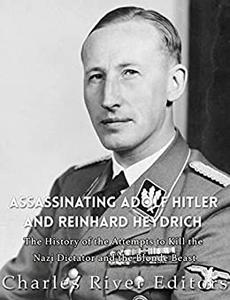 Assassinating Adolf Hitler and Reinhard Heydrich: The History of the Attempts to Kill the Nazi Dictator and the Blond Beast by Charles River Editors English | August 11, 2016 | ISBN: 1537008323 | 130 pages | EPUB | 3.13 Mb *Includes pictures *Includes accounts detailing various attempts to kill Hitler and the assassination of Heydrich *Includes online resources and a bibliography for further reading Like other totalitarian regimes, the leader of the Nazis kept an iron grip on power in part by making sure nobody else could attain too much of it, leading to purges of high-ranking officials in the Nazi party. Of these purges, the most notorious was the Night of the Long Knives, a purge in the summer of 1934 that came about when Hitler ordered the surprise executions of several dozen leaders of the SA. Nonetheless, for the most part Hitler enjoyed great popularity among both the members of the Wehrmacht and ordinary Germans during his rule over the Third Reich between 1934 and 1945. To many, he appeared to be the spirit of a revived, powerful Germany, shaking off the hardship and humiliation imprudently inflicted by the victorious western Allies at the end of World War I. His strangely magnetic, ranting speeches struck a chord with millions, creating iron loyalty in many of those who followed the commands of his dictatorship. From the very beginning, however, others held a different view of the newly constituted Third Reich's Fuhrer. Though the concept of tyrannicide remained so foreign to German culture that the word only appeared in the national language after World War II, as the war progressed and Germany's fortunes faltered, more individuals and groups Descriptionted the death of Hitler. Through it all, Hitler eluded many of the attempts on his life without ever realizing his risk. Most Descriptionters escaped undetected, baffled by the randomness and secretive nature of Hitler's movements. The Fuhrer frequently canceled prearranged engagements, arrived at other locations with only a few minutes' advance notice, used different trains than originally planned, and generally proved constantly unpredictable. When Hitler traveled by air, he not only brought a detachment of fanatical SS guards, but also highly trusted personal physicians and cooks, and his own personal car, the latter armored and already thoroughly checked for sabotage and booby traps. Beyond all his precautions, the Fuhrer sometimes almost appeared protected by incredible - or uncanny - luck. Despite the enmity of the world and the increasingly violent opposition of his own officers, the Third Reich's leader lived until he chose to die, as though destined by some dark fate to perish only by his own hand. The assassination of Reinhard Heydrich stands out as one of the war's most remarkable secret operations. "The man with the iron heart," as Adolf Hitler dubbed him, made a fitting target for the dramatic events which unfolded in Prague on May 27th, 1942. According to testimony by the historian Michael Freund, "He is one of the greatest criminal figures of the Third Reich. Nowhere in the histories of the Third Reich has [Heydrich] been awarded his rightful place. He is a man of outstanding significance, a criminal mind of Luciferic grandeur." (Dederichs, 2009, 17). During the early stages of the war, the Reich Protector often walked the streets of Prague alone or with just one or two escorts, and he also favored an open-topped Mercedes 320-C convertible, which left him fully exposed to snipers, bomb throwers, and the like. Though he was ordered by the Fuhrer to install armored plates inside the seat backs to limit the effect of grenades hurled into the interior of his vehicle, these armor pieces remained idle in the castle garage on the date of Heydrich's assassination. By contrast, Heydrich found time to have expensive horsehair upholstery installed in the touring car, providing a springy, comfortable ride. That would be all the good fortune a British-trained team of Czech assassins would need.  Anca I. Lasc, "Architectures of Display: Department Stores and Modern Retail " English | ISBN: 1472468457 | 2017 | 292 pages | PDF | 19 MB Through an international range of case studies from the 1870s to the present, this volume analyzes strategies of display in department stores and modern retail spaces. Established scholars and emerging researchers working within a range of disciplinary contexts and historiographical traditions shed light on what constitutes modern retail and the ways in which interior designers, architects, and artists have built or transformed their practice in response to the commercial context. |

 :
:
