
| |
|
|
[center]
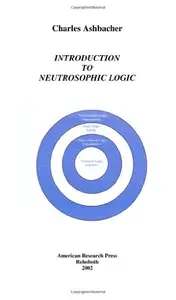 Free Download Introduction to Neutrosophic Logic By Charles Ashbacher 2002 | 145 Pages | ISBN: 1931233608 | PDF | 1 MB Neutrosophic Logic was created by Florentin Smarandache (1995) and is an extension / combination of the fuzzy logic, intuitionistic logic, paraconsistent logic, and the three-valued logics that use an indeterminate value.Definition of Neutrosophic Logic:Let T, I, F be standard or non-standard real subsets of the non-standard unit interval ]-0, 1+[,with sup T = t_sup, inf T = t_inf,sup I = i_sup, inf I = i_inf,sup F = f_sup, inf F = f_inf,and n_sup = t_sup+i_sup+f_sup,n_inf = t_inf+i_inf+f_inf.Of course, -0 <= n_inf <= n_sup <= 3+.A logic in which each proposition is estimated to have the percentage of truth in a subset T,the percentage of indeterminacy in a subset I, and the percentage of falsity in a subset F,where T, I, F are defined above, is called Neutrosophic Logic.The sets T, I, F are not necessarily intervals, but may be any real sub-unitary subsets: discrete or continuous; single-element, finite, or (countable or uncountable) infinite; union or intersection of various subsets; etc.They may also overlap. The real subsets could represent the relative errors in determining t, i, f (in the case when the subsets T, I, F are reduced to points).Statically T, I, F are subsets. But dynamically, looking therefore from another perspective, the components T, I, F are at each instance dependant on many parameters, and therefore they can be considered set-valued vector functions or even operators.T, I, and F are called neutrosophic components, representing the truth, indeterminacy, and falsehood values respectively referring to neutrosophy, neutrosophic logic, neutrosophic set, neutrosophic probability, neutrosophic statistics.This representation is closer to the reasoning of the human mind. It characterizes / catches the imprecision of knowledge or linguistic inexactitude perceived by various observers (that's why T, I, F are subsets - not necessarily single-elements), uncertainty due to incomplete knowledge or acquisition errors or stochasticity (that's why the subset I exists),and vagueness due to lack of clear contours or limits (that's why T, I, F are subsets and I exists; in particular for the appurtenance to the neutrosophic sets).The advantage of using neutrosophic logic is that this logic distinguishes between relative truth, that is a truth in one or a few worlds only, noted by NL(relative truth)=1, and absolute truth, that is a truth in all possible worlds, noted by NL(absolute truth)=1+. And similarly, neutrosophic logic distinguishes between relative falsehood, noted by 0, and absolute falsehood, noted by -0.In neutrosophic logic the sum of components is not necessarily 1 as in classical and fuzzy logic, but any number between -0 and 3+, and this allows the neutrosophic logic to be able to deal with paradoxes, propositions which are true and false in the same time: thus NL(paradox)=(1, I, 1); fuzzy logic can not do this because in fuzzy logic the sum of components has to be 1.[/center]  Free Download Introduction to N-Adaptive Fuzzy Models to Analyze Public Opinion on Aids By W. B. Vasantha Kandasamy, Florentin Smarandache 2006 | 236 Pages | ISBN: 1931233128 | PDF | 1 MB People living with HIV/AIDS have always been victims of the most extreme forms of social discrimination. They are stereotyped and stigmatized, and are seen as people outside the 'general population'.In this book The authors use mathematical tools to attempt an understanding of public awareness and attitude towards people living with HIV/AIDS.Here, for the first time, a new model, called n-adaptive fuzzy model, has been introduced. This model has the capacity to analyze the same problem in different ways thereby arriving at various solutions that mirror multiple perspectives.  Free Download Introduction to Indoor fish farming by Dhanaji Patil English | January 10, 2024 | ISBN: 1774698382 | 255 pages | PDF | 28 Mb World population is growing exponentially with increasing demand in food security. Aquaculture is one of the fastest-growing, food-producing sectors accounting for nearly 50% of the world's fish production. Aquaculture is culture of aquatic plants and animals in aquatic environment. Last few decades, aquaculture is becoming more reliable, efficient and sustainable source of high quality food production. Though, its major goal is to produce aquatic food for human consumption, but also has other goals, such as ornamental and sport fish cultivation. It also reduces stress on capture fishery which under threat due to over-fishing, habitat loss or other changes due to possible pollutants they have consumed or been exposed. However, aquaculture technology is continuously advancing through technological innovation to maximise yield/ha with less inputs and impact on environment. The farming of aquatic animals in controlled environment such as tanks, ponds or RAS in indoor premises is known as indoor fish farming. Indoor fish farming is one of the source of animal protein production to this day, especially in locations far from the sea. It allows fish to be raised in a controlled and optimised environment with increased control on water quality, feeding and diseases monitoring. Though, it requires significant initial investment, planning and expertise to establish, but has more advantages over open culture. Moreover, it is possible in urban area or area where land and water scarcity. Optimal water quality for the good health and growth of cultured fish species is achieved through proper oxygenation, feeding, filtration and removal of waste products to get control on ammonia, nitrate and nitrite. It too offers potential benefits in terms of water conservation, reduced environmental impact, efficient resource utilization, optimal FCR and risk of fish escapement. This book scientifically focuses on advances, operation, economics, management as well as challenges and safety in indoor aquaculture along with its impact on human beings. This book also touches SSFs, capture fisheries and its subsequent management. This book potentially serves as a manual for interested aquaculturist, policy makers as well as students pursuing graduation, post-graduation and research studies.  Free Download Introduction to Generative AI, Second Edition English | 2025 | ISBN: 1633434885 | 496 pages | True EPUB | 5.34 MB AI tools like ChatGPT and Gemini, automated coding tools like Cursor and Copilot, and countless LLM-powered agents have become a part of daily life. They've also spawned a storm of misinformation, hype, and doomsaying that makes it tough to understand exactly what Generative AI actually is and what it can really do. This book delivers a clear, well-written survey of generative AI fundamentals along with the techniques and strategies you need to use AI safely and effectively.  Free Download Introduction to Generative AI, Second Edition (MEAP V02) English | 2025 | ISBN: 9781633434882 | 200 pages | MOBI | 2.49 Mb Get up to speed quickly with generative AI!  Free Download Introduction to Generative AI, Second Edition (MEAP 06) English | 2025 | ISBN: 9781633434882 | 541 pages | PDF, EPUB | 29.4 MB Get up to speed quickly with generative AI! 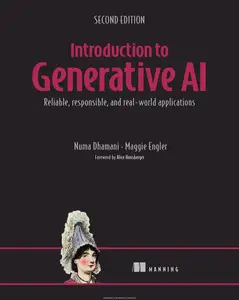 Free Download Introduction to Generative AI, Second Edition (Final) English | 2026 | ISBN: 1633434885 | 511 pages | True PDF | 39.2 MB Get up to speed quickly with generative AI!  Free Download Introduction to Facilities Management: Foundational Skills for Effective Workplace Operations by David Morris, Sue Morris English | September 9, 2025 | ISBN: 1394316046 | 160 pages | MOBI | 1.45 Mb Provides the essential skills required for effective facilities management 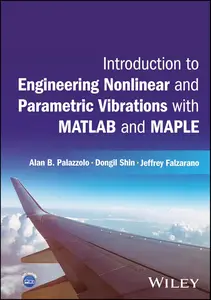 Free Download Introduction to Engineering Nonlinear and Parametric Vibrations with MATLAB and Maple by Alan B. Palazzolo, Dongil Shin, Jeffrey Falzarano English | July 14, 2025 | ISBN: 1119319544 | 640 pages | MOBI | 60 Mb Textbook on nonlinear and parametric vibrations discussing relevant terminology and analytical and computational tools for analysis, design, and troubleshooting 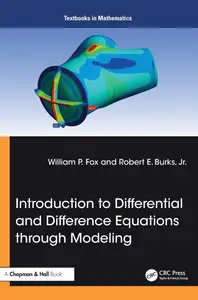 Free Download Introduction to Differential and Difference Equations through Modeling (Textbooks in Mathematics) by William P. Fox, Robert E. Burks Jr. English | July 8, 2025 | ISBN: 1032949007 | 337 pages | MOBI | 13 Mb This book presents an opportunity to learn difference and differential equations through a modeling-first approach. The text is meant as an introduction to those equations and not as a text only for modeling courses. No previous exposure to these equations is expected. Modeling in Introduction to Differential and Difference Equations through Modeling is presented as the vehicle for learning difference and differential equations. |

 :
:
