
| |
|
|
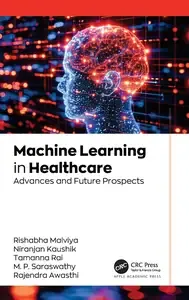 Machine Learning in Healthcare: Advances and Future Prospects by Rishabha Malviya, Niranjan Kaushik, Tamanna Rai English | September 14, 2025 | ISBN: 1779640005 | 150 pages | MOBI | 4.56 Mb This new volume explores the integration of machine learning in healthcare, which has transformed technology for disease diagnosis, treatment, and management. The book shows the enormous possibilities made possible by computational technologies, ranging from analyzing electronic health information to predicting, detecting, and treating cancer, cardiovascular disease, thyroid disorders, and diabetes. The exploration extends beyond conventional domains, discussing topics such as wearable devices and mental health management through the use of machine learning technology.  Machine Learning for Volatility Forecasting: LSTMs, Transformers, and Regime Models: Deep Learning Models for Realized Volatility, Implied Vol Surfaces, and Regime-Switching Risk in Python by James Preston, Danny Munrow English | September 18, 2025 | ISBN: N/A | ASIN: B0FRRDZVK9 | 681 pages | EPUB | 0.60 Mb Reactive Publishing  Machine Learning for Engineers by Ajit Singh English | July 16, 2025 | ISBN: N/A | ASIN: B0FHWHV3J6 | 234 pages | EPUB | 0.23 Mb "Machine Learning for Engineers" is a foundational textbook meticulously crafted to introduce B.Tech and M.Tech engineering students to the principles and practices of Machine Learning (ML). This book serves as a bridge, connecting the theoretical underpinnings of ML algorithms with their practical application in solving complex engineering problems. Recognizing that the engineers of tomorrow must be adept at leveraging data, this book demystifies ML, making it accessible, intuitive, and directly relevant to their discipline.  Jitendra Kumar, "Machine Learning for Cloud Management" English | ISBN: 0367626489 | 2021 | 198 pages | MOBI | 13 MB Cloud computing offers subscription-based on-demand services, and it has emerged as the backbone of the computing industry. It has enabled us to share resources among multiple users through virtualization, which creates a virtual instance of a computer system running in an abstracted hardware layer. Unlike early distributed computing models, it offers virtually limitless computing resources through its large scale cloud data centers. It has gained wide popularity over the past few years, with an ever-increasing infrastructure, a number of users, and the amount of hosted data. The large and complex workloads hosted on these data centers introduce many challenges, including resource utilization, power consumption, scalability, and operational cost. Therefore, an effective resource management scheme is essential to achieve operational efficiency with improved elasticity. Machine learning enabled solutions are the best fit to address these issues as they can analyze and learn from the data. Moreover, it brings automation to the solutions, which is an essential factor in dealing with large distributed systems in the cloud paradigm. 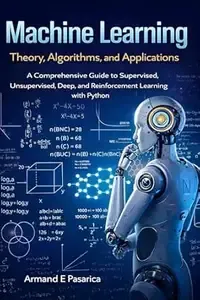 Machine Learning: Theory, Algorithms, and Applications : A Comprehensive Guide to Supervised, Unsupervised, Deep, and Reinforcement Learning with Python English | 24 Jan. 2026 | ASIN: B0GJJT98DB | 1005 pages | Epub | 800.53 KB Machine Learning is at the core of modern artificial intelligence, driving innovation across industry, finance, transportation, and cybersecurity. This book offers a comprehensive and rigorous treatment of machine learning , combining solid mathematical foundations with real-world applications and hands-on implementations. Covering supervised, semi-supervised, unsupervised, deep, and reinforcement learning , the book explains both classical and modern algorithms, including linear and logistic regression, decision trees, random forests, support vector machines, Bayesian models, neural networks, CNNs, LSTMs, GANs, and reinforcement learning methods based on Markov decision processes. With hundreds of pages of in-depth explanations , practical case studies, and problem sets with full solutions , readers will learn how to design, analyze, and deploy machine learning models using Python and MATLAB . Advanced topics such as statistical learning theory, bias-variance trade-off, regularization, optimization, probabilistic inference, and hyperparameter tuning are treated in detail. The book also presents unique industrial and economic applications , including fraud detection, manufacturing optimization, computer vision, natural language processing, cyber-attack detection, and the development of virtual sensors for autonomous vehicles , addressing the challenges of the green economy. Designed for graduate students, researchers, engineers, and professionals , this book serves both as a textbook and a long-term reference for mastering machine learning theory and practice. 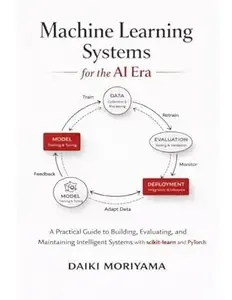 Machine Learning Systems for the AI Era: A Practical Guide to Building, Evaluating, and Maintaining Intelligent Systems with scikit-learn and PyTorch ... of Software and Data Systems in the AI Era) English | 11 Jan. 2026 | ASIN: B0GG9YV76H | 342 pages | EPUB (True) | 3.21 MB Machine learning has matured-but most books still treat it as a collection of models rather than a system that must survive real-world use. In practice, machine learning fails not because of weak algorithms, but because of poor problem framing, fragile data pipelines, misleading evaluation, and neglected feedback loops. Models that look impressive in notebooks often break quietly in production. Metrics drift. Assumptions decay. Decisions made early become constraints years later. Machine Learning Systems for the AI Era is written for practitioners who want to move beyond training models and learn how to build machine learning systems that actually work-end to end, over time, and under real constraints. This book treats machine learning as an engineering discipline. It shows how learning algorithms interact with data, evaluation, deployment, and maintenance, and how those interactions determine long-term success far more than model choice alone. Using scikit-learn for disciplined classical workflows and PyTorch for transparent deep learning, the book develops a unified mental model that connects fundamentals to modern architectures-without hiding complexity behind abstractions or oversimplified recipes. You will learn how to: Frame machine learning problems correctly before models are chosen Design robust data splits, evaluation strategies, and feedback loops Understand bias, variance, and generalization as system properties-not just metrics Build and reason about classical models, ensembles, and dimensionality reduction with scikit-learn Transition cleanly from linear models to neural networks and deep learning Implement, debug, and train models in PyTorch with full visibility into training dynamics Work with convolutional networks, sequence models, transformers, generative models, and reinforcement learning-without losing architectural clarity Evaluate models honestly, avoid leakage, and compare classical and deep approaches responsibly Deploy models, monitor drift, plan retraining, and maintain systems over time A dedicated chapter on time-series and sequence modeling addresses a critical gap often ignored in general ML books, highlighting temporal pitfalls that frequently invalidate real-world results. What Makes This Book Different: This is not a "learn machine learning fast" book. It does not promise shortcuts, tricks, or copy-paste architectures. Instead, it focuses on judgment . You will learn why certain approaches work, when they fail, and how early decisions propagate through the lifecycle of a machine learning system. The emphasis is on clarity, evaluation discipline, and long-term thinking-the qualities that distinguish production-grade systems from demos. Code examples favor readability and correctness over cleverness. Concepts are explained with minimal mathematics but rigorous reasoning. Modern tools are used carefully, with attention to their tradeoffs rather than their marketing narratives. Who This Book Is For: Software engineers transitioning into machine learning Machine learning practitioners who want stronger foundations and systems intuition Data scientists frustrated by models that fail outside experimentation Technical leads and architects responsible for ML decisions at scale A working knowledge of Python is assumed. Build Systems That Learn-and Keep Working If you want to build machine learning systems that are not only accurate, but reliable, explainable, and maintainable , this book provides the foundation. Order now and learn how modern machine learning actually works-in practice.  Machine Learning: Python for Data Science : A Practical Guide to Building, Training, Testing and Deploying Machine Learning / AI models by Nikhil Khan English | September 21, 2025 | ISBN: B0FKKNQT9W | 297 pages | EPUB | 1.28 Mb Machine Learning: Python for Data Science (Book 3) A Practical Guide to Building, Training, Testing, and Deploying Machine Learning / AI Models  Machine Learning Interview Guide: Job-oriented questions and answers for data scientists and engineers (English Edition) by Rehan Guha English | December 26, 2024 | ISBN: 936589199X | 346 pages | PDF | 2.75 Mb Description  Hui Jiang, "Machine Learning Fundamentals: A Concise Introduction" English | ISBN: 1108837042 | 2022 | 420 pages | MOBI | 3 MB This lucid, accessible introduction to supervised machine learning presents core concepts in a focused and logical way that is easy for beginners to follow. The author assumes basic calculus, linear algebra, probability and statistics but no prior exposure to machine learning. Coverage includes widely used traditional methods such as SVMs, boosted trees, HMMs, and LDAs, plus popular deep learning methods such as convolution neural nets, attention, transformers, and GANs. Organized in a coherent presentation framework that emphasizes the big picture, the text introduces each method clearly and concisely "from scratch" based on the fundamentals. All methods and algorithms are described by a clean and consistent style, with a minimum of unnecessary detail. Numerous case studies and concrete examples demonstrate how the methods can be applied in a variety of contexts.  Machine Dreams Economics Becomes a Cyborg Science By Philip Mirowski 2002 | 655 Pages | ISBN: 0521775264 | PDF | 9 MB This is the first cross-over book in the history of science written by an historian of economics, combining a number of disciplinary and stylistic orientations. In it Philip Mirowshki shows how what is conventionally thought to be "history of technology" can be integrated with the history of economic ideas. His analysis combines Cold War history with the history of the postwar economics profession in America and later elsewhere, revealing that the Pax Americana had much to do with the content of such abstruse and formal doctrines such as linear programming and game theory. He links the literature on "cyborg science" found in science studies to economics, an element missing in the literature to date. Mirowski further calls into question the idea that economics has been immune to postmodern currents found in the larger culture, arguing that neoclassical economics has surreptitiously participated in the desconstruction of the integral "Self." Finally, he argues for a different style of economics, an alliance of computational and institutional themes, and challenges the widespread impression that there is nothing else besides American neoclassical economic theory left standing after the demise of Marxism. Philip Mirowski is Carl Koch Professor of Economics and the History and Philosophy of Science, University of Notre Dame. He teaches in both the economics and science studies communities and has written frequently for academic journals. He is also the author of More Heat than Light (Cambridge, 1992) and editor of Natural Images in Economics (Cambridge, 1994) and Science Bought and Sold (University of Chicago, 2001). |

 :
:
