
| |
|
|
 Brian W. King, "Language, Gender and Biopolitics: Meaning-Making and Intersex Variations in Healthcare " English | ISBN: 1009202499 | 2026 | 75 pages | PDF | 743 KB This Element examines language, power and intersex variations within clinician accounts in Hong Kong, examining how they communicate about intersex traits to patients and their families. Employing interactional sociolinguistics, the research analyses clinician interviews as dynamic social interactions, focusing on how communicative stances are negotiated and social practices are enacted. The Element probes the influence of biopower on clinicians' stances (encompassing gender, sexual difference, racialization and ableism) and explores the possibilities of emancipation from these biopolitical constraints. Findings highlight the tension between medical structuring forces and the formation of intersex subjects and bodies, impacting their autonomy and livability. Gender is relevant as both a power system and a lived reality, critical for understanding the bioregulation of innate sex characteristics and advancing broader implications for gender and language studies and healthcare communication. This research challenges gender-sceptical discourses and highlights the transformative potential of gender frameworks in medical and social contexts.  Language in the Mind: An Introduction to Guillaume's Theory by Walter Hirtle English | August 13, 2007 | ISBN: 0773532633, 9780773577862 | True EPUB | 288 pages | 2.3 MB Guillaume sees the word as the link between language as potential and as actual discourse. Meaning is both the representation of the speaker's momentary experience and the determining factor in the the word's use in discourse. Walter Hirtle illustrates Guillaume's general principles with examples drawn from contemporary English grammar and uses comparisons with other approaches, especially cognitive linguistics, to situate Guillaumes distinctive view of language as essentially a mental phenomenon.  Daniel Dejica, "Language in the Digital Era: Challenges and Perspectives" English | ISBN: 311047204X | | pages | AZW3 | 8 MB This collected volume brings together the contributions of several humanities scholars who focus on the evolution of language in the digital era. The first part of the volume explores general aspects of humanities and linguistics in the digital environment. The second part focuses on language and translation and includes topics that discuss the digital translation policy, new technologies and specialised translation, online resources for terminology management, translation of online advertising, or subtitling. The last part of the book focuses on language teaching and learning and addresses the changes, challenges and perspectives of didactics in the age of technology. Each contribution is divided into several sections that present the state of the art and the methodology used, and discuss the results and perspectives of the authors. The book is recommended to scholars, professionals, students and anyone interested in the changes within the humanities in conjunction with technological innovation or in the ways language is adapting to the challenges of today's digitized world.  Language in Society (Routledge Guides to Linguistics) by Nala H. Lee English | 2025 | ISBN: 1032621443 | 190 Pages | True ePUB | 0.41 MB  Language in Society (Routledge Guides to Linguistics) by Nala H. Lee English | 2025 | ISBN: 1032621443 | 190 Pages | True PDF | 2 MB  Language and the Rise of the Algorithm English | May 31, 2024 | ASIN: B0BNXC11DR | 327 pages | EPUB (True) | 7.04 MB A wide-ranging history of the algorithm. Bringing together the histories of mathematics, computer science, and linguistic thought, Language and the Rise of the Algorithm reveals how recent developments in artificial intelligence are reopening an issue that troubled mathematicians well before the computer age: How do you draw the line between computational rules and the complexities of making systems comprehensible to people? By attending to this question, we come to see that the modern idea of the algorithm is implicated in a long history of attempts to maintain a disciplinary boundary separating technical knowledge from the languages people speak day to day. Here Jeffrey M. Binder offers a compelling tour of four visions of universal computation that addressed this issue in very different ways: G. W. Leibniz's calculus ratiocinator; a universal algebra scheme Nicolas de Condorcet designed during the French Revolution; George Boole's nineteenth-century logic system; and the early programming language ALGOL, short for algorithmic language .These episodes show that symbolic computation has repeatedly become entangled in debates about the nature of communication. Machine learning, in its increasing dependence on words, erodes the line between technical and everyday language, revealing the urgent stakes underlying this boundary. The idea of the algorithm is a levee holding back the social complexity of language, and it is about to break. This book is about the flood that inspired its construction.  Language and Professional Identity: Aspects of Collaborative Interaction (Palgrave Studies in Professional and Oganizational Discourse) By Keith Richards 2006 | 260 Pages | ISBN: 1403938008 | PDF | 1 MB This book explores the ways in which professional groups develop specific interactional procedures for conducting and representing their activities, all of which contribute to a distinctive collaborative identity. It highlights the drawbacks as well as the advantages of collaborative talk, pointing to ways of improving professional performance. Its investigation of topics such as identity, argument, narrative, and metaphor means that it should appeal to researchers outside the fields of applied linguistics and professional communication, for whom it is primarily intended.  Dwi Noverini Djenar, "Language and Identity across Modes of Communication " English | ISBN: 1614513872 | 2015 | 367 pages | MOBI | 4 MB This edited collection examines how people use a range of different modalities to negotiate, influence, and/or project their own or other people's identities. It brings together linguistic scholars concerned with issues of identity through a study of language use in various types of written texts, conversation, performance, and interviews. 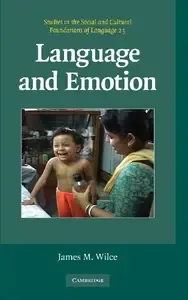 Language and Emotion (Studies in the Social and Cultural Foundations of Language) By James M. Wilce 2009 | 248 Pages | ISBN: 0521864178 | PDF | 3 MB Language is a means we use to communicate feelings; we also reflect emotionally on the language we and others use. James Wilce analyses the signals people use to express emotion, looking at the social, cultural and political functions of emotional language around the world. The book demonstrates that speaking, feeling, reflecting, and identifying are interrelated processes and shows how desire or shame are attached to language. Drawing on nearly one hundred ethnographic case studies, it demonstrates the cultural diversity, historical emergence, and political significance of emotional language. Wilce brings together insights from linguistics and anthropology to survey an extremely broad range of genres, cultural concepts, and social functions of emotional expression.  Language Development and Education: Children With Varying Language Experiences By Paula Menyuk, Maria Estela Brisk 2005 | 240 Pages | ISBN: 1403921202 | PDF | 1 MB The book describes both the remarkable changes in language knowledge and use that occur from infancy through high school, and also the differences in the process due to variations in experience. What has been found to be good educational practice during each of these stages is discussed, emphasizing that among other things, good practice involves awareness of, and planning for, diversity in the abilities of children. |

 :
:
