
| |
|
|
 The Little Book of Mathematical Principles, Theories, & Things English | 15 Jan. 2016 | ISBN: 1435104897 | 224 pages | EPUB (True) | 2.14 MB Verlag: The Little Book of Mathematical Principles, Theories & Things, erklärt über 120 Gesetze, Prinzipien, Gleichungen, Paradoxen und Theoremen, die die Grundlage moderner Mathematik sind. Erklärt die Zahlen von Fibonacci, Zenos Paradoxen und Euclid Elemente sowie die wesentlichen Dinge wie Chaotheorie, Spieltheorie und natürlich das Spiel des Lebens.  The Literature of Ireland: Culture and Criticism By Terence Brown 2010 | 293 Pages | ISBN: 0521136520 | PDF | 2 MB One of Ireland's foremost literary and cultural historians, Terence Brown's command of the intellectual and cultural currents running through the Irish literary canon is second to none, and he has been enormously influential in shaping the field of Irish studies. These essays reflect the key themes of Brown's distinguished career, most crucially his critical engagement with the post-colonial model of Irish cultural and literary history currently dominant in Irish Studies. With essays on major figures such as Yeats, MacNeice, Joyce and Beckett, as well as contemporary authors including Seamus Heaney, Derek Mahon, Michael Longley, Paul Muldoon and Brian Friel, this volume is a major contribution to scholarship, directing scholars and students to new approaches to twentieth-century Irish cultural and literary history.  The Limits to Governance By Catherine Lyall, James Smith 2009 | 300 Pages | ISBN: 0754675084 | PDF | 2 MB Does the state still frame debates about new technology? How can policy-makers ensure that we benefit from the health developments brought by genomics while satisfying both the expectations of society and the economic imperatives? This book offers a critique of the new governance agenda for science and innovation in the context of the life sciences, and particularly genomics. The authors argue that the governance of genomics presents policy-makers worldwide with a variety of new problems. Biotechnology promises a great deal but has in many respects still to deliver on these promises and concerns persist about risks, ethics and the north-south dimensions of this global endeavour. The backdrop to the book is the emergence of new governance structures and policy processes in Europe and North America over the past decade. The authors argue that, despite the political rhetoric about new governance approaches, the state's capacity to control debates about new technology endures. They suggest that, in the face of the multi-faceted policy and regulatory situation that applies to the life sciences, we need to consider the situation as a form of government - governance continuum where different aspects of genomics and life science technologies may sit at different points - and indeed co-exist. Thinking about governance and government as a duality can help to offer some valuable lessons for policy.  The Limerence Recovery Workbook: 21 days to break the dopamine loop, obsessive thoughts and detach from your L.O. when no contact seems impossible. English | 21 Jan. 2026 | ASIN: B0GHZKFPFJ | 128 pages | EPUB (True) | 3.07 MB You're not unwell. You're in a loop. If you can't stop thinking about someone or checking, fantasizing, replaying every moment, craving one more sign, this is for you. The 21-Day Limerence Workbook is a short, structured daily plan to help you detach with clarity, reduce obsessive thoughts, and stop feeding the cycle (even if No Contact is hard or not fully possible). In just 15-25 minutes a day, you'll learn to: Break the rumination + "dopamine hit" pattern Handle withdrawal (cravings, panic, sadness, relapse urges) Set boundaries that actually stick (work/coworker, shared spaces, online) Stop idealizing them and see the situation clearly Rebuild self-respect and emotional stability day by day Each day includes a brief lesson, guided exercises, prompts, and a simple tracker so you can see progress. If you're tired of losing your peace to the same person in your head... Start Day 1 today.  The Life of Ralph Waldo Emerson English | June 20, 2025 | ISBN: 9781475329094 | 54 Pages | EPUB (True) | 2.34 MB "Standing on the bare ground, - my head bathed by the blithe air, and uplifted into infinite space, - all mean egotism vanishes. I become a transparent eye-ball; I am nothing; I see all; the currents of the Universal Being circulate through me; I am part or particle of God." - Ralph Waldo Emerson  The Life of Matthew Flinders By Miriam Estensen 2004 | 568 Pages | ISBN: 1741141524 | PDF | 3 MB The compelling story of the life and times of Matthew Flinders, one of Australia's - and history's - greatest explorers. From the author of 'Discovery'.  The Life and Philosophy of Plato English | June 6, 2025 | ISBN: 9781475336238 | 52 Pages | EPUB (True) | 2.97 MB "Until philosophers are kings, or the kings and princes of this world have the spirit and power of philosophy, and political greatness and wisdom meet in one, and those commoner natures who pursue either to the exclusion of the other are compelled to stand aside, cities will never have rest from their evils - no, nor the human race, as I believe - and then only will this our State have a possibility of life and behold the light of day." - Plato, The Republic  Jane Aikin, "The Library of Congress: From Jefferson's Vision to the Digital Age" English | ISBN: 1647125715 | 2025 | 356 pages | PDF | 29 MB The first comprehensive history of the Library of Congress  The Legal Regime of the International Criminal Court (International Humanitarian Law) By Jose Doria, Hans-Peter Gasser, M. Cherif Bassiouni 2009 | 1122 Pages | ISBN: 9004163085 | PDF | 9 MB This impressive and unique collection of essays covers important aspects of the legal regime of the International Criminal Court (ICC). The volume begins with an analysis of the historical development of the ICC. 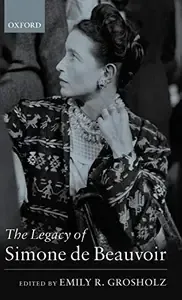 The Legacy of Simone de Beauvoir By Emily R. Grosholz 2004 | 240 Pages | ISBN: 0199265356 | PDF | 1 MB The legacy of Simone de Beauvoir has yet to be properly assessed and explored. The 50th anniversary of the publication of The Second Sex inspired this volume, which brings together philosophers and literary critics, some of whom are well known for their books on Beauvoir (Bauer, Le Doeuff, Moi), others new to Beauvoir studies though long familiar with her work (Grosholz, Imbert, James, Stevenson, Wilson). One aim of this collection is to encourage greater recognition of Beauvoir's philosophical writings through systematic reflection on their place in the canon and on her methods. The Second Sex played a central role in the profound shift in philosophy's self-understanding that took place in the latter half of the twentieth century, and today offers new problems for reflection and novel means for appropriating older texts. Its reflective iconoclasm can be compared to that of Descartes' Meditations; its enormous, directly discernible impact on our social world invites comparison with Locke's Two Treatises of Government. The collection also examines the relationship between Beauvoir's literary writing and her philosophical thought. Deeply concerned with the critical and creative powers of reason as well as with the betterment of our suffering world, Simone de Beauvoir wrote in a variety of genres in addition to the philosophical essay: the novel, political journalism, and the memoir. The multiplicity of her voices was closely related to her philosophical project. Since Beauvoir's method (like that of W. E. B. du Bois) proceeded from her own immediate experience, her reflections had to find expression sometimes as narrative, sometimes as autobiography, sometimes as argument. The Legacy of Simone de Beauvoir demonstrates the many ways in which Beauvoir's writings, in particular The Second Sex, can serve as resources for thought, for the life of the mind which is as concerned with the past and future as it is with the present. |

 :
:
