
| |
|
|
TutorialsExplore Comprehensive Tutorials for Various SkillsAccess a wide range of tutorials on various topics, including technology, design, business, and more. Whether you're a beginner or an expert, find the perfect tutorial to help you improve your skills and achieve your goals.  Duration: 10m | 5 Lessons | Video: 1280x720, 44kHz | 141 MB Genre: eLearning | Language: English | Level: All levels In just 10 minutes you will quickly learn how to set up the rendering of your 3D designs with Physical Render.  MP4 | Video: h264, 1280x720 | Audio: AAC, 44.1 KHz, 2 Ch Skill Level: Beginner | Genre: eLearning | Language: English + srt | Duration: 56m | Size: 110.4 MB This course covers the basics of the SAP in-house Rapid Application Development tool, Business Rule Framework (BRF+). The course starts with the basics of Rapid Application Development (RAD), then provides an introduction to the concepts and strengths of BRF+. Also covered are the differences between waterfall and agile project management, and details on how to integrate BRF+ into each workflow.  MP4 | Video: h264, 1280x720 | Audio: AAC, 44.1 KHz, 2 Ch Skill Level: Beginner | Genre: eLearning | Language: English + srt | Duration: 2h 55m | Size: 466.1 MB If you're an SAP developer or ABAP programmer looking to expand your skills into SAP BI-IP or BPC Embedded, this course is for you. Learn to design, configure, and roll out a complete planning application inside SAP BPC embedded or BI-IP. The course starts with the design of a simple planning action to familiarize you with the basic functionality and terminology available in BI-IP, before drilling down into more complex functionality to enable you to design more advanced planning applications. This course also helps you understand the various options for reporting and planning within the Embedded/BI-IP environment, and goes over how to create and maintain planning functions in BI-IP and Embedded.  MP4 | Video: h264, 1280x720 | Audio: AAC, 44.1 KHz, 2 Ch Skill Level: Beginner | Genre: eLearning | Language: English + srt | Duration: 1h 20m | Size: 162.5 MB If you're an ABAP programmer considering the transition from classic ABAP programming to an object-oriented style programming style, this course shows you the advantages of using ABAP Objects, the object-oriented programming feature of ABAP. This course discusses reasons for implementing programming standards and the use of standardized frameworks for writing code, before getting into detailed examples of code reuse with ABAP Objects. Other topics include powerful techniques to handle and report error conditions in your ABAP programs, and how to incorporate automated test routines into development and maintenance cycles. By the end of this course, you'll be on your way to a better understanding of the different ways that objects can be reused for different business problems, and have knowledge to help you produce efficient and easily maintainable code in a short amount of time.  MP4 | Video: h264, 1920x1080 | Audio: AAC, 44.1 KHz, 2 Ch Genre: eLearning | Language: English | Duration: 95 Lessons (14h) | Size: 3.1 GB Be a Developer in the Fastest Growing UI Framework!  MP4 | Video: h264, 1920x1080 | Audio: AAC, 44.1 KHz, 2 Ch Genre: eLearning | Language: English | Duration: 20 Lessons (1h) | Size: 211.1 MB There are three Boolean operators in Python: and, or, and not. With them, you can test conditions and decide which execution path your programs will take. In this tutorial, you'll take a deep dive into the Python or operator and how to use it. 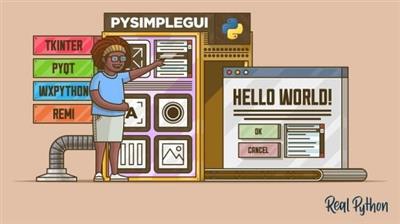 MP4 | Video: h264, 1920x1080 | Audio: AAC, 44.1 KHz, 2 Ch Genre: eLearning | Language: English | Duration: 9 Lessons (35m) | Size: 140.9 MB Creating a simple graphical user interface (GUI) that works across multiple platforms can be complicated. But it doesn't have to be that way. You can use Python and the PySimpleGUI package to create nice-looking user interfaces that you and your users will enjoy! PySimpleGUI is a new Python GUI library that has been gaining a lot of interest recently.  MP4 | Video: h264, 1280x720 | Audio: AAC, 44.1 KHz, 2 Ch Genre: eLearning | Language: English | Duration: 10 Lessons (32m) | Size: 70.4 MB When you start building any new Django web application, there's a basic setup you need to tackle first. This course outlines the necessary steps to set up a Django project.  MP4 | Video: h264, 1280x720 | Audio: AAC, 44.1 KHz, 2 Ch Skill Level: Advanced | Genre: eLearning | Language: English + srt | Duration: 5h 12m | Size: 898.5 MB User authentication is a critical part of virtually every website, yet few web developers know all the details behind how it works and how to use it to provide a good user experience. In this course, instructor Shaun Wassell dives into the details behind user authentication in the context of React and how to incorporate user authentication into React applications. Shaun begins with some definitions, steps, and basic authentication projects. Then he discusses in-depth email verification and how to set it up. Shaun explains how to give users the ability to reset their passwords, then describes the steps in setting up OAuth. He goes over several prebuilt authentication options, then concludes with some best practice recommendations.  Jason Roberts | Duration: 2h 06m | Video: H264 1280x720 | Audio: AAC 44,1 kHz 2ch | 403 MB | Language: English + SUB NUnit is one of the most downloaded test frameworks for .NET. This course will teach you everything you need to know to get started testing your code, including asserts, categories, data-driven tests, customization, and how to reduce test code duplication Releasing bug-ridden code to production is a sure fire way of creating unhappy end-users, management, and development teams. Nobody likes to receive a phone call in the middle of the night saying that the production system has gone down and needs fixing, immediately. In this course, Introduction to .NET Testing with NUnit 3, you will gain the ability to create automated tests for you code. First, you will learn how to set up a test project and run tests. Next, you will discover the different ways to assert on test results such as numbers, collections, and expected exceptions. Finally, you will explore how to customize the test execution lifecycle, create data driven tests, and customize NUnit. When you're finished with this course, you will have the skills and knowledge of automated testing with NUnit needed to help prevent bugs from making their way into production. |

 :
:
