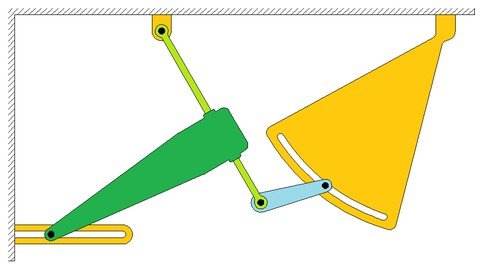
Last updated 7/2022 MP4 | Video: h264, 1280x720 | Audio: AAC, 44.1 KHz Language: English | Size: 341.12 MB | Duration: 1h 45m A course with easy lessons and step-by-step exercises with solutions for students interested in Theory of Machines
What you'll learn Understand common types of kinematic constraints such as the revolute, prismatic and rigid joints Experience more complex constraints such as the pin-on-slot joint as well as the sliding and rolling contacts Master how to analyze a mechanical system to determine its Degrees of Freedom Learn how to deal with challenging cases such as over-constrained systems Find lots of examples to have a clear picture of complex concepts Practice what you have learned by completing a set of easy to complex exercises with detailed solutions Get prepared for the exam via a quick review of the entire course followed by some more complex exercises Have a chance to take a final exam and self-assess your progress using the provided solutions Requirements No requirements. You will learn everything needed about the rigid bodies and the kinematic joints in order to determine the Degrees of Freedom in a Mechanical System. Description In this course, you will master many types of kinematic joints and will be able to analyze a mechanical system to determine its Degrees of Freedom. You will understand common kinematic constraints such as the revolute, prismatic and rigid joints, and will learn how to deal with challenging cases such as over-constrained systems. You will also experience some more complex constraints such as the pin-on-slot joint, and the sliding and rolling contacts. During each lecture, you will find enough examples and illustrations to fully grasp the concepts and have a clear picture of them. After each lecture, there will be several exercises for you to practice what you have learned. Following each exercise, you will have access to my detailed solutions in a separate lecture, which might be a good chance for you to compare with yours and evaluate your learning process. After completing all the lessons, there will be a review section giving you a quick summary of all you have learned followed by some more complex exercises from the entire course. The role of this review is to make you prepared for the final exam coming at the end of the course. You can finally assess your exam using the provided solutions and celebrate your progress. Overview Section 1: Introduction and Course Outline Lecture 1 Introduction and Course Outline Section 2: Understand Common Kinematic Joints Lecture 2 Revolute Joint Lecture 3 Prismatic Joint Lecture 4 Rigid Joint Lecture 5 Exercise: Common Kinematic Joints Lecture 6 Solution: Common Kinematic Joints Lecture 7 Deal with Revolute Joints between Convergent Links Lecture 8 Exercise: Revolute Joints between Convergent Links Lecture 9 Solution: Revolute Joints between Convergent Links Lecture 10 Simplify a Triangle of Pinned Links Lecture 11 Identify Over-Constrained Cases Lecture 12 Exercise: Over-Constrained Cases Lecture 13 Solution: Over-Constrained Cases Section 3: Understand Pin on Slot Joint Lecture 14 Pin on Slot Joint Lecture 15 Exercise: Pin on Slot Joint Lecture 16 Solution: Pin on Slot Joint Section 4: Learn Sliding and Rolling Contacts Lecture 17 Sliding and Rolling Contacts Lecture 18 Exercise: Sliding and Rolling Contacts Lecture 19 Solution: Sliding and Rolling Contacts Section 5: Course Review and More Complex Exercises Lecture 20 Course Review Lecture 21 Exercise: Course Review Lecture 22 Solution: Course Review Section 6: Course Exam Lecture 23 Course Exam Lecture 24 Solution: Course Exam Students of Engineering interested in Theory of Machines,Anyone curious about kinematic joints and mobility of mechanisms