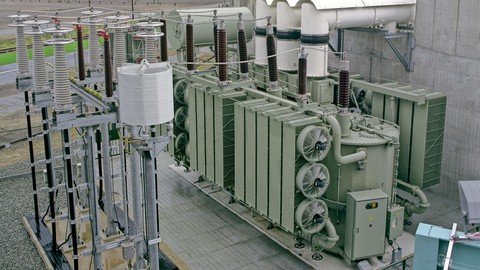
Last updated 7/2022 MP4 | Video: h264, 1280x720 | Audio: AAC, 44.1 KHz Language: English | Size: 638.35 MB | Duration: 1h 57m Learn from Professionals, Electrical Power Engineering
What you'll learn Parts of Transformer Why Oil is used in power transformers Transformer Polarity How to perform polarity test of transformer Main Tank and Conservator Tank Sealed Tank or hermetically sealed Transformer Silica Gel and Breather Function of Radiator Direction of oil flow in radiator Radiator Thermographic Image Types of Radiators Types of Cooling, Why Two ratings are given at name plate of transformer Which factor is decisive for max loading capacity of transformer What factor effect most for transformer aging Effect of temperature on paper aging Risks when wet transformer is overheated What is soak test and why it is done why humming sound is observed in power transformer, Magnetostriction Effect When humming sound of transformer is increased Buchholz Relay Where Buchholz relay is installed Buchholz Relay Working Principle Buchholz Functional Check NO contacts of Buchholz Relay Buchholz Bleeding and Test Point Transportation and protection of Buchholz relay contact Buchholz internal, view Directional mark on Buchholz relay Buchholz gas sampling device Buchholz Manufacturer Operating Details Sudden Oil Pressure Relay Oil and Winding Temperature Indicator Oil Level Indicator Pressure Relief Device Bushing of Transformer and Bushing Test Tap Moisture is worst enemy of bushing Periodical Check and maintenance of the bushing of transformer HV Bushing Inspection glass Requirements Eager to learn Description Dear Hi,A transformer is a static machine used for transforming power from one circuit to another without changing the frequency. As there is no rotating or moving parts, a transformer is classified as a static device. Transformer operates on an AC supply. Transformers operate based on the principle of mutual induction.Power transformers are called heart of power system, they are essential part and required for transmission and distribution of power supply.I have prepared this course considering theoretical and practical aspects, you will certainly feel the difference when experience professional is delivering the knowledge. This course consist of 164 Video Lectures and total duration of 11 Hours. This is the most comprehensive training online for transformers.Find below details of topics covered in this training.Topics covered in Part 1:1 Transformer Definition and Uses2 Can transformer increase of decrease power?3 Do transformer have any rotating part?4 why high voltages are used to transmit power?5 do transformer work on dc, if not what are HVDC transformer used in dc transmission?6 What was decisive weapon in winning war from dc system and prevailing of ac system?7 DC system is coming back8 Generation, transmission, distribution network diagram9 Why rating of transformer is given in KVA not kW?10 Transformer Symbol11 Transformer Basic Diagram12 what are primary and secondary windings?13 What changes are to be made if the primary and secondary winding?14 Ferromagnetism, how core act when coil is energized15 Electric field, Magnetic field, Electromagnetic field16 Transformer Basic Operating Principle17 Self Inductance18 Mutual Inductance19 Mutual induction n distance of coupling20 Coupling Coefficient21 Coupling Factor Between Coils22 Mutual Inductance Calculation Example No123 How transformer works, how secondary current is reflected to primary on load?24 Do Transformer Change frequency25 Leakage flux and reactance of transformer26 Transformer Equivalent Circuit Explained27 Calculating Voltage at primary and secondary sides considering reactance and resistances28 Understanding voltage drop in transformer due to leakage reactance.29 Magnetic fringing Effect30 Reduction in hotspot temperature by reducing fringing effect in transformerTopics covered in Part 2:31 How to minimize flux leakage32 EMF Equation of transformer33 Can 50,60Hz transformers be used interchangeably34 Power in single n three phase transformer35 Ideal Transformer36 Real Transformer37 Reflected Load in a Transformer38 Types of Transformer39 Power and Distribution Transformers40 Classification of Transformer as per Cooling System41 Oil Filled, Dry Type Transformer, Self and forced cooling42 Why Radiators are used in transformer43 Instrument Transformer44 Current Transformer45 Voltage Transformer or Potential Transformer46 Zig Zag Transformer47 Step Up and Step Down Transformer48 Isolation Transformer for Safety and reduce voltage spikes49 Single Phase and Three Phase Transformer50 Power Vs Auto Transformer51 Theoretical Vs Practical Transformer52 Winding arrangement in transformer, concentric, sandwich or pancake53 Core Type and Shell Type Transformers54 Type of wire used in transformer55 Core Stepping or Cruciform56 Feature most important for transformer design57 Transformer Voltage Regulation58 Transformer Efficiency and all day efficiency59 Do high voltage regulation transformer are better60 Relationship between Voltage regulation n Z of transformerTopics covered in Part 3:61 Losses in Transformers62 Eddy Current Loss63 Transformer Core Requirements64 Transformer without core laminations65 Air Gap Cored Transformer66 Hysteresis Losses67 Copper Losses68 Losses Due to Magnetic leakage, Stray Losses69 Measures to reduce losses in transformer70 Which Losses in Transformer are fixed and variable71 Transformer core Loss Vs Frequency, Flux Density72 Transformer Core Saturation73 Over Excitation Protection of Transformer74 Power transformer design to withstand how much over flux75 Effect of Over Fluxing in Transformers76 Transformer Body Earthing77 Transformer Core and Clamp Grounding78 Should Transformer Core and Clamp need to be grounded79 One Vs Several Transformer and Parallels operation of transformer80 Do Power Transformer be converted to auto transformer81 Why at least one delta winding is provided in power transformers83 Interesting Facts about Percentage Impedance of transformer84 Tesla CoilTopics covered in Part 4:85 Parts of Transformer86 Why Oil is used in power transformers87 Transformer Polarity88 How to perform polarity test of transformer89 Main Tank and Conservator Tank90 Sealed Tank or hermetically sealed Transformer91 Silica Gel and Breather92 Function of Radiator93 Direction of oil flow in radiator94 Radiator Thermographic Image95 Types of Radiators96 Types of Cooling, Why Two ratings are given at name plate of transformer97 Which factor is decisive for max loading capacity of transformer98 What factor effect most for transformer aging99 Effect of temperature on paper aging100 Risks when wet transformer is overheated101 What is soak test and why it is done102 Why humming sound is observed in power transformer, Magnetostriction Effect103 When humming sound of transformer is increased104 Buchholz Relay105 Where Buchholz relay is installed106 Buchholz Relay Working Principle107 Buchholz Functional Check108 NO contacts of Buchholz Relay109 Buchholz Bleeding and Test Point110 Transportation and protection of Buchholz relay contact111 Buchholz internal, view112 Directional mark on Buchholz relay113 Buchholz gas sampling device114 Buchholz Manufacturer Operating Details115 Sudden Oil Pressure Relay116 Oil and Winding Temperature Indicator117 Oil Level Indicator118 Pressure Relief Device119 Bushing of Transformer and Bushing Test Tap120 Moisture is worst enemy of bushing121 Periodical Check and maintenance of the bushing of transformer122 HV Bushing Inspection glassTopics covered in Next parts:123 Creepage Distance, Clearance Distance and arcing horn124 HV bushing maintenance125 Rupture Disc126 Sudden Oil Pressure Relay127 Tap Changers Types and requirements128 Make before break patent of onload tap changer by Dr Janson 1927129 Tap Changer Winding Arrangements130 Off load tap changer131 On Load Tap Changer132 On Load Tap changer Working133 OLTC Sequence of operation in detail134 OLTC General Arrangements135 What is the basic difference between Transition Resistance and Reactor type136 What are the advantages of vacuum type OLTC137 What preventive maintenance, measures can be used for improvement in life138 Tie In Resistor in Tap Changer139 Tap Changer Design Methodologies140 Tap Changer Animation141 Air Bleeding in Transformer142 Test Performed On Transformer144 Transformer Turn Ratio Test145 Purpose Transformer Open circuit and short circuit test146 Transformer Open Circuit Test147 Short Circuit Test of Transformer148 Impedance Test of Transformer149 C and DF or Tan Delta Test of transformer150 How to Predict the Result of Tan Delta Testing151 Sweep Frequency Response Analysis Test152 DC winding Resistance Test153 Transformer Demagnetization after Winding Resistance Test154 Going Through Transformer FAT Report155 Transformer Name Plate156 Transformer General Arrangement Drawing157 Vector Group and Clock Method158 How to draw winding connection if you know vector group159 Testing Vector Group By Voltage Method160 Transformer Troubleshooting161 Preventive Maintenance of transformer162 How Transformers are transported163 Corona Rings at transformer bushing164 Transformer Fire Protection SystemRegardsElite Engineering Overview Section 1: Introduction Lecture 1 Introduction Section 2: Parts of Transformers Lecture 2 Parts of Transformers Section 3: Transformer Polarity Lecture 3 Transformer Polarity Section 4: How to perform polarity test of transformer Lecture 4 How to perform polarity test of transformer Section 5: Main Tank and Conservator Tank Lecture 5 Main Tank and Conservator Tank Section 6: Sealed Tank or hermetically sealed Transformer Lecture 6 Sealed Tank or hermetically sealed Transformer Section 7: Silica Gel and Breather Lecture 7 Silica Gel and Breather Section 8: Function of Radiator Lecture 8 Function of Radiator Section 9: Direction of oil flow in radiator Lecture 9 Direction of oil flow in radiator Section 10: Radiator Thermographic Image Lecture 10 Radiator Thermographic Image Section 11: Types of Radiators Lecture 11 Types of Radiators Section 12: Types of Cooling, Why Two ratings are given at name plate of transformer Lecture 12 Types of Cooling, Why Two ratings are given at name plate of transformer Section 13: Types of Cooling, Why Two ratings are given at name plate of transformer Lecture 13 Types of Cooling, Why Two ratings are given at name plate of transformer Section 14: Which factor is decisive for max loading capacity of transformer Lecture 14 Which factor is decisive for max loading capacity of transformer Section 15: What factor effect most for transformer aging Lecture 15 What factor effect most for transformer aging Section 16: Effect of temperature on paper aging Lecture 16 Effect of temperature on paper aging Section 17: Risks when wet transformer is overheated Lecture 17 Risks when wet transformer is overheated Section 18: What is soak test and why it is done Lecture 18 What is soak test and why it is done Section 19: why humming sound is observed in power transformer, Magnetostriction Effect Lecture 19 Why humming sound is observed in power transformer, Magnetostriction Effect Section 20: When humming sound is observed in power transformer is increased? Lecture 20 why humming sound is observed in power transformer, Magnetostriction Effect Section 21: Buchholz Relay Lecture 21 Buchholz Relay Section 22: Where buchholz relay is installed Lecture 22 Where buchholz relay is installed Section 23: Buchholz Relay Working Principle Lecture 23 Buchholz Relay Working Principle Section 24: Buchholz Functional Check Lecture 24 Buchholz Functional Check Section 25: NO contacts of Buchholz Relay Lecture 25 NO contacts of Buchholz Relay Section 26: Buchholz Bleeding and Test Point Lecture 26 Buchholz Bleeding and Test Point Section 27: Transportation and protection of buchholz relay contact Lecture 27 Transportation and protection of buchholz relay contact Section 28: Buchholz internal, view Lecture 28 Buchholz internal, view Section 29: Directional mark on buchholz relay Lecture 29 Directional mark on buchholz relay Section 30: Buchholz gas sampling device Lecture 30 Buchholz gas sampling device Section 31: Buchholz Manufacturer Operating Details Lecture 31 Buchholz Manufacturer Operating Details Section 32: Sudden Oil Pressure Relay Lecture 32 Sudden Oil Pressure Relay Section 33: Oil and Winding Temperature Indicator Lecture 33 Oil and Winding Temperature Indicator Section 34: Oil Level Indicator Lecture 34 Oil Level Indicator Section 35: Pressure Relief Device Lecture 35 Pressure Relief Device Section 36: Bushing of Transformer and Bushing Test Tap Lecture 36 Bushing of Transformer and Bushing Test Tap Section 37: Moisture is worst enemy of bushing Lecture 37 Moisture is worst enemy of bushing Section 38: Periodical Check and maintenance of the bushing of transformer Lecture 38 Periodical Check and maintenance of the bushing of transformer Section 39: HV Bushing Inspection glass Lecture 39 HV Bushing Inspection glass Students, Engineers, Technicians