

 :
:
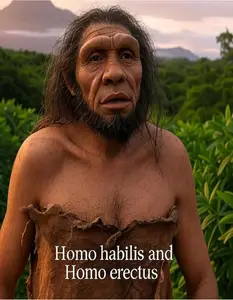
Free Download Homo habilis and Homo erectus: The History and Legacy of Modern Humans' Direct Ancestors by Charles River Editors
English | March 6, 2025 | ISBN: N/A | ASIN: B0DZMRTVXP | 140 pages | EPUB | 9.17 Mb
The evolutionary path from the original primates to modern man is a long one and has taken many twists and turns, but naturally, as the fossil record grows, scientists gain a more complete understanding of our own mental and physical history in terms of genetics and anatomy. However, the correct order and relationships of the various specimen types are difficult to pin down. Many representative samples have been found in such minute amounts as to not preclude anomalies. They have been discovered in various stages of wear. Modern features did not occur simultaneously or uniformly, taking millions of years to become manifest in later types. Up to the present day's Homo sapiens, examples of the main types have been hybrids of older and more modern features.
One of the earliest species of the genus Homo to be discovered is Homo habilis, which basically means "handy man." The name comes from the belief at the time of its discovery that this species was the first to start using stone tools. The first fossils to be uncovered in Olduvai Gorge were from the same stratigraphic layer as simple stone tools. Fossils of the crania and postcranial skeleton for this species have been found in both eastern and southern Africa and date to around 2.5-1.6 million years ago.
Given the gradual changes that take place in evolution, Homo habilis shares a number of characteristics that are similar to the genus Australopithecus, such as in the postcranial elements. That said, the size and shape of the Homo habilis skull are markedly different. The size of the brain is much larger relative to the size of the body, being around 680 cc. In order to house a larger brain, the skull features a more vertical frontal bone, creating a more vertical forehead. The brow ridges that sit on the lower portion of the frontal bone are also reduced in size. Other reductions in the face include reduced prognathism and a reduction in the size of the premolars and molars.
What is generally accepted is that Homo habilis was capable of making stone tools. These tools were flakes that were broken off from a core and had sharp edges. These tools could serve a number of purposes, such as cutting up the remains of an animal or cleaning its skin. But while Homo habilis almost certainly used tools, scholars still debate which species of Homo actually began making stone tools first since the species Homo rudolfensis also lived during the same time.
Features of Homo erectus suggest an evolution toward modern humans, and the features which separate Homo erectus from the other Homo species are found in the skull. The size of the brain was approximately 900 cc, making it larger than the brain size of Homo habilis. Homo erectus would not have the largest brain capacity of the Homo genus during its existence, with the emergence of Homo heidelbergensis approximately 800,000 years ago. The larger brain size may not matter much when the size of the brain is considered with the size of the body, which also increased.
The development of the skull also changed in Homo erectus. While the body became larger, the brain case did not become more vertical relative to the body, resulting in a sloping and long appearance similar to an American football. Other features that developed on the skull are thicker brow ridges and the development of bony projections at the rear of the skull.
While the facial features of Homo erectus would have made them noticeably different if they were alive today, their postcranial morphology may have been similar to modern humans. A key difference is the density or thickness of the bones; in Homo erectus the limb bones are more robust, but otherwise they appear very similar to modern humans. In fact, the length of the hindlimbs in relation to the arms is similar to modern humans.
Links are Interchangeable - Single Extraction