

 :
:
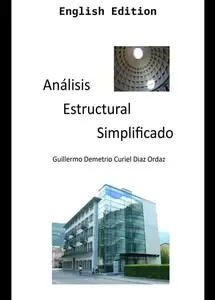
Simplified Structural Analysis
by Guillermo Demetrio Curiel Diaz Ordaz
English | 2026 | ASIN: B0GHQ3P2CX | 189 pages | pdf | 58 MB
This book presents the fundamental concepts of structural analysis using a simplified approach.
Topics covered include stiffness matrices, mass matrices, static structural analysis, forced displacement concepts at supports, response spectra, modal analysis, stiffness matrix condensation, modal damping, and structural response to seismic events.
Any structure can be viewed globally as a cantilever beam fixed to the ground, where the foundation must resist both vertical and horizontal loads transmitted from the structure. Using this concept, we can develop simplified mathematical models based on beam stiffness matrices. Chapter 1 presents the theory and procedures for creating simplified structural models, illustrated with multiple examples.
Chapter 2 examines various structural system configurations-specifically, how to arrange structural elements to achieve both safety and economy. Key concepts include:
The critical role of horizontal loads.
Benefits of incorporating tie beams in foundation systems.
The choice between flat slab construction versus beam-and-slab systems.
Comparing rigid frame construction with truss-frame systems.
Challenges presented by arches and vaults.
Roof structure analysis.
Shear deformation effects.
Chapter 3 covers soil fundamentals, including the Unified Soil Classification System, foundation types, isolated footing design, and soil-structure interaction modeling using spring elements. These concepts are presented from an accessible perspective to help structural engineers understand soil behavior, while leaving detailed soil capacity determination to geotechnical specialists.
Chapter 4 explains earthquake phenomena, seismic wave transmission through soil, the influence of local soil conditions on structural response, and site-specific response spectra. The chapter includes computer software for generating acceleration time histories from response spectra.
Chapter 5 addresses wind effects on structures and essential design considerations. Multiple examples demonstrate wind pressure calculations using the wind design manual from Mexico's Federal Electricity Commission.
Chapter 6 presents matrix methods for analyzing structures under static loads. Building on the beam stiffness matrix introduced in Chapter 1, this chapter explores rotation matrices and forced displacement analysis, featuring complete step-by-step examples of static analysis and forced displacement problems.
Chapter 7 covers modal analysis fundamentals, including vibration mode determination with detailed step-by-step examples. Topics include stiffness matrix condensation techniques, participation factors, generalized stiffness and mass properties, structural response using response spectra, modal combination methods, and modal damping calculations-all supported by comprehensive examples.
Appendix A provides a simplified introduction to matrix algebra, answering fundamental questions: What defines a matrix? What are diagonal, identity, and triangular matrices? What is matrix transposition? How do you perform matrix addition, subtraction, multiplication, and inversion?
Buy Premium From My Links To Get Resumable Support,Max Speed & Support Me
Links are Interchangeable - Single Extraction