

 :
:
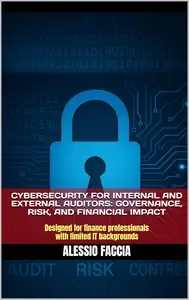
Cybersecurity for Internal and External Auditors: Governance, Risk, and Financial Impact: Designed for finance professionals with limited IT backgrounds by Alessio Faccia
English | July 26, 2025 | ISBN: N/A | ASIN: B0FJZZ7YWR | 209 pages | EPUB | 1.91 Mb
Cybersecurity for Internal and External Auditors: Governance, Risk, and Financial Impact offers a forensic perspective on the critical intersection between information security and audit assurance. Designed for financial professionals who do not possess a technical background, this book translates the implications of cybersecurity failures into matters of control, governance, accountability, and audit risk.
Rather than reciting generic threats or promoting overstated solutions, the author dissects how specific cyber events-such as unauthorised access, data loss, and system vulnerabilities-impact the audit process. The volume presents real institutional scenarios and examines how failures in digital architecture can distort financial reporting, impair oversight, or be deliberately concealed through weak internal controls.
The book is structured around three dimensions:
1. Governance and Compliance
It highlights how the absence of effective cybersecurity governance mechanisms reflects broader organisational deficiencies. It explores board-level blind spots, ineffective risk registers, failure of incident response protocols, and governance gaps exposed through cyber crises.
2. Internal Control and Risk Management
A detailed examination of cyber risk as a financial and operational exposure. The book links cybersecurity to COSO and ISO control environments, clarifying how missing or poorly implemented controls can compromise confidentiality, integrity, and availability of information assets.
3. Audit Responsibility and Professional Judgement
It challenges internal and external auditors to reconsider their professional role: not to act as IT experts, but to understand how digital exposures influence the control environment and audit evidence. The text examines engagement planning, fraud detection, third-party risks, and the implications of non-financial digital assets in scope.
Rather than advocating for more reporting or new standards, the author proposes that existing audit methods must be applied more rigorously to digital threats, and that weak control environments often mask deeper cultural and managerial issues. Examples include overreliance on outsourced IT providers, lack of segregation in system access, and failures to act on known vulnerabilities.
This book is essential reading for:Internal auditors seeking clarity on how cybersecurity links to assurance over controls and processesExternal auditors preparing for engagements where system risks impact financial materialityRisk officers and compliance professionals examining accountability frameworksAudit trainees and postgraduate students aiming to align IT risks with professional auditing standardsAccessible, methodical, and grounded in practical audit work, this book provides a reference point for those who must interpret cybersecurity not as an abstract threat, but as a measurable component of organisational reliability and auditor responsibility.
Buy Premium From My Links To Get Resumable Support,Max Speed & Support Me
Links are Interchangeable - Single Extraction