

 :
:
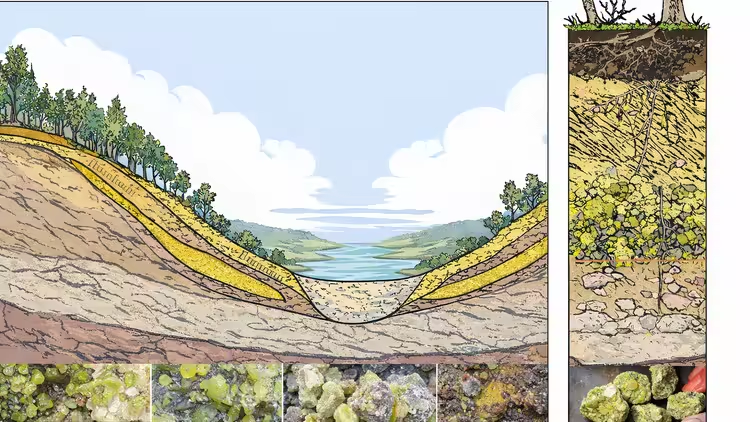
Free Download Ion Adsorption Clay REE ( Rare Earth Elements) Deposits
Published 2/2026
MP4 | Video: h264, 1920x1080 | Audio: AAC, 44.1 KHz, 2 Ch
Language: English | Duration: 57m | Size: 835.22 MB
Formation, Supergene Weathering, REE Mobility, Clay Adsorption & Heavy Rare Earth Enrichment
What you'll learn
Explain how ion-adsorption clay deposits form and how supergene weathering concentrates heavy rare earth elements (HREEs).
Identify the geological, climatic, and geochemical conditions required for deposit development and preservation.
Analyze REE mobility, adsorption mechanisms, and fractionation patterns to assess enrichment potential.
Evaluate exploration strategies using mineral systems thinking, including regolith analysis and ion-exchangeable REE testing.
Assess mining methods (in-situ and heap leaching), hydrogeological controls, and slope stability considerations.
Interpret economic drivers such as HREE basket value, recoverability, cost structure, and market sensitivity.
Understand ESG, environmental monitoring, and regulatory considerations unique to leaching-based REE extraction.
Apply integrated geological, geochemical, and economic analysis to evaluate real-world ion-adsorption clay projects.
Requirements
No prior experience in rare earth geology is required — the course is structured from fundamentals to advanced concepts.
A basic understanding of high school–level geology, chemistry, or earth sciences is helpful but not mandatory.
Interest in critical minerals, mining, sustainability, or energy transition topics will enhance learning.
No programming or specialized software experience is required.
A willingness to engage with geological diagrams, geochemical concepts, and economic analysis is beneficial.
Description
Ion-adsorption clay rare earth element (REE) deposits are the world's primary source of heavy rare earth elements (HREEs) — critical materials used in electric vehicles, wind turbines, defense systems, and high-performance electronics. Despite their relatively low grade, these deposits are economically vital due to their simple extraction methods and strategic importance.
This course provides a comprehensive geological and geochemical understanding of ion-adsorption clay REE systems. You will begin with the fundamental geological setting — exploring REE-rich granites and volcanic rocks, parent rock geochemistry, and mineral sources. We then examine supergene weathering processes, including chemical breakdown of primary silicate minerals, clay mineral formation, and vertical zonation within weathering profiles.
A major focus of this course is REE mobility and enrichment. You will learn how rare earth elements are liberated during weathering, how they migrate through regolith profiles, and how ion-exchange and surface complexation mechanisms control adsorption onto clay minerals such as kaolinite and halloysite. The course also explains REE fractionation processes, heavy REE enrichment mechanisms, and the economic implications of these geochemical controls.
Finally, we integrate geology with mining reality — covering deposit geometry, grade variability, mining methods, hydrogeological considerations, and environmental constraints.
By the end of this course, you will understand ion-adsorption clay deposits as complete mineral systems — from parent rock to economic extraction — enabling you to apply this knowledge in exploration, mining, and critical minerals project development.
Who this course is for
Geology, mining, and earth science students seeking practical understanding of rare earth deposits.
Oil & gas professionals (drilling, reservoir, subsurface, and production engineers) looking to transition into the critical minerals and energy transition sector.
Early-career geologists, geochemists, hydrogeologists, and mining engineers working in critical minerals.
Professionals in rare earth exploration, resource modeling, and in-situ leaching operations.
ESG, environmental, and regulatory specialists involved in solution-based mining projects.
Investors, policy analysts, and strategic supply chain professionals evaluating heavy rare earth projects.
Anyone interested in understanding how geology, chemistry, and sustainability intersect in critical mineral supply. This positions the course as technical, strategic, and industry-relevant.
Buy Premium From My Links To Get Resumable Support,Max Speed & Support Me
No Password - Links are Interchangeable